Both times, the fix was people Ford had already decided it could do without. Right now, you're deciding about yours.
In 1921, Henry Ford let the man who knew how to build cars walk out the door.
By 1927 it had cost him the lead.
Ninety-nine years later, Ford Motor Company did it again.
This time it cost three years, 350 engineers, and a quality crisis they had to buy their way out of.
Same company. Same address. Same mistake.
And both times, nobody noticed until the bill came.
None of us are exempt from this, by the way.
I'll show you why in a minute.
The Part That Just Happened
Ford Motor Company spent this year hiring back 350 engineers it no longer had.
Some were former employees. Some had drifted off to suppliers.
Ford calls them "gray beards." Fair enough.
(Salute to the salt & pepper gang by the way.)
The point is, they came back because Ford had leaned on AI for vehicle quality, and the systems weren't catching what the veterans used to catch.
Charles Poon, Ford's VP of vehicle hardware engineering, said it on a press call:
"Mistakenly, we thought that by just introducing artificial intelligence and ingesting the design requirements that we had, that would produce a high quality product."
Then he said the thing that should have been the headline.
The veteran technicians had already left.
Before their knowledge could be used to train the tools that replaced them.
That's worth reading twice.
The AI didn't fail because the AI was bad.
The AI failed because the only people who could tell it what "good" meant were gone before anyone thought to ask.
So Ford Motor Company went out and bought that knowledge back on the open market.
Some of it from their own suppliers.
In other words, they paid retail for something they used to already have access to.
1921: The Man Ford Couldn't Stand
1921.
What's interesting is that a decade earlier, Ford had bought a parts mill in Buffalo and gotten a Danish immigrant in the deal.
Bill Knudsen.
By 1919, Knudsen was running production at Highland Park. He'd built Ford's Eagle boats during the war. He had drawn up the plan for Ford's operations across all of Europe.
But, Henry Ford found him difficult.
Independent.
He started overruling him.
Knudsen was making $50,000 a year plus a bonus.
Call it a million in today's money.
But on April 1, 1921, that didn't stop him from walking out with nothing lined up.
No offer. No plan.
He told a friend he couldn't stay and keep his self-respect.
Ford asked him to take a long vacation instead.
Knudsen spent the next ten months making stove trimmings.
Nobody from Ford called. Ever.
Then General Motors did.
They started him at $30,000.
Three weeks later they made him VP of Chevrolet, and put him back to fifty.
GM had a better system than Ford. Sloan built it.
Then they handed Knudsen the division that would be used against Ford.
In 1921, Chevrolet built 75,700 cars.
By 1927, Chevrolet built 1,001,680.
That May, Henry Ford shut down the Model T line, laid off 60,000 people, and went dark for six months.
There was no replacement designed. Think about that.
Let's be real about what that means.
He sent everyone home and then started drawing the next car.
One more thing worth pointing out, because if we're being fair, Knudsen didn't cause that shutdown alone.
Henry Ford caused it.
He refused to change the Model T for nineteen years.
He'd built the car that put the country on wheels, and he could not accept that the thing which made him right in 1908 was making him wrong by 1925.
The assumption that made you successful is the one you'll defend the longest. And it's the one most likely to be out of date.
Knudsen just made sure someone was standing there to take the market while Ford defended his.
Ford didn't just lose to a better system. He handed a piece of it to the man he'd found annoying.
Neither One Was an Accident
Here's the thing about both of these.
Ford didn't lose that knowledge. Not in 1921. Not in 2026.
He decided he didn't need it.
Knudsen wasn't attrition.
He wasn't a retirement.
He was a guy Henry Ford found irritating, and figured he could do without.
And the gray beards weren't misplaced.
They were surplus to an efficiency plan that assumed the AI could do what they did.
Both times, Ford decided the person (the people) were worth less than the friction they caused.
Both times, Ford was wrong by an order of magnitude they couldn't have imagined.
That's not a knowledge management problem.
That's a judgment problem about whose judgment matters.
And you're making it right now. (You might be making it today.)
None of Those Numbers Are Your Size
Here's where I lose half of you.
Fine. Let me lose you on purpose.
Ford has 170,000 employees.
You run a business with eleven people and a good year behind you.
So why does any of this matter?
Because the pattern was never about the budget.
It's about who knows why.
Ford had thousands of people who knew why.
You have three. Maybe two. And one of them is you.
When Ford lost them, they could go buy them back.
That's what the 350 hires were.
An open market for the expertise they'd let walk out the door, and enough money to shop in it.
You don't have that.
There is no open market for what's in your head. When it goes, it doesn't get repurchased. It just stops existing.
Ford's version of this failure was expensive.
Yours is terminal.
Every generation reruns this.
- In the nineties companies bought systems to capture what everyone knew, and nobody ever typed anything into them.
- In the two-thousands we spent eighteen months migrating to the platform that ran everything, and six years later there was still one thing that only worked if Denise did it in a spreadsheet.
- In the twenty-teens we hoarded every scrap of data because insight would show up later. Gartner warned those lakes would turn into swamps. They did.
Different decade. Different vendor. Same unpaid bill.
Call it what it is.
Extraction debt.
The Seat Is Being Bought
Now here's what happened in July, and I need you to hold onto it.
Microsoft launched a unit called Frontier Company.
Two and a half billion dollars.
Roughly 6,000 engineers, consultants, and specialists whose entire job is to go sit inside client organizations and make the AI produce something measurable.
Amazon put in a billion.
Meta is standing up a unit to place its own engineers and product managers directly inside large corporate clients.
Eight billion dollars. To send humans into buildings.
Not to improve the model. The model is fine.
To supply the one thing the model has never had.
Someone in the room who knows what good looks like.
I drew this progression a year ago, and gave that person a name.
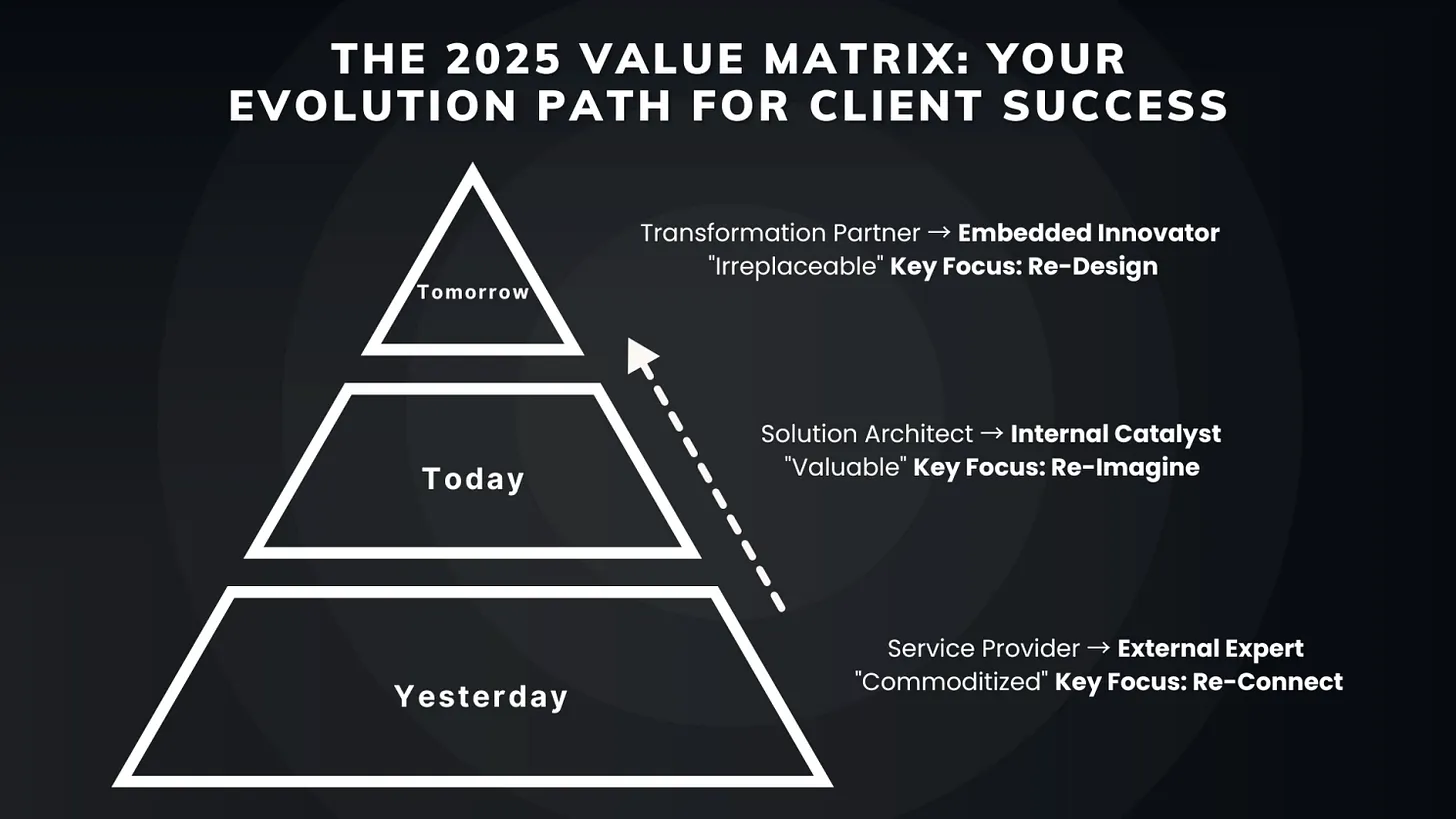
External Expert. Internal Catalyst. "Embedded Innovator".
I wrote it as a prediction.
Nobody argued with it. Not enough people acted on it either.
Microsoft, Amazon, and Meta just put eight billion dollars behind it.
They're not selling software anymore.
They're buying the seat. The one next to your client, inside the building, where the judgment lives.
And being right a year early is worth exactly nothing to you if you can't afford the version they're buying.
So let's talk about the version you can.
Where Does Yours Come From?
You can't hire one at that scale.
Microsoft can field 6,000 because Microsoft can pay for 6,000.
You have a headcount plan and a payroll.
And neither has a slot for a forward-deployed anything.
There are three doors. I haven't seen a fourth yet.
Door One: It's already you.
You are the Embedded Innovator in your own business.
The judgment is yours. You have it. That was never the problem.
What you don't have is it written down.
Which means it can't leave your head.
Which means it can't train anything.
Which means it can't be audited.
So the business can't compound. Can't be sold. Can't survive you taking a real vacation.
Your bottleneck was never capability. It's extraction.
Door Two: It's somebody on your team.
This is the Knudsen door.
Not the most senior person. Not the most technical.
Look for the one who gets asked the questions that aren't in the SOP.
The one who can tell you why you turned that client down, not just that you did.
The one who spots that an output is wrong before they can explain how they knew.
The one who quietly gets handed the messy accounts.
Maybe you've got a name in your head right now.
A few weeks back I asked what would happen to your business if you were completely unavailable for thirty days. No email, no calls, no quick questions.
If you flinched, that's normal.
Because everybody doesn't have this dialed in yet. And that's okay.
But here's the harder version.
What happens if they disappear for thirty days?
If you flinched at that one too, you already know what they're carrying.
You just haven't written any of it down.
Now look at the same person again.
They push back in meetings.
They tell you things you don't want to hear.
They have opinions about work that isn't theirs.
Same person. Same trait.
The independent manner that reads as friction is the judgment you'd pay good money to extract.
You don't get one without the other. Henry Ford tried.
Quick test.
Who on your team are you quietly deciding you'd be better off without?
If you answered that fast. That may be the problem.
Ford answered it on April 1, 1921.
And he was wrong by a million cars.
Door Three: Somebody from outside holds the methodology while it gets built.
Door Three exists because Doors One and Two have a chicken-and-egg problem.
You're too far inside your own business to extract yourself. And your internal candidate can't audit against a standard nobody's written.
Look at what the gray beards actually came back to do.
They didn't come back to inspect parts.
Ford pulled them off daily production and put them on mandatory weekly design reviews, hunting failure points before anything reached the plant floor.
They came back to train the system and audit its output.
That's what a documented methodology is, operationalized.
The Bill Came Due Twice
Ford paid the same bill twice.
In 1927 it cost him the lead. In 2026 it cost them three years and 350 engineers.
But here's what you should key in on.
The second time, once they finally paid it, the numbers came back.
Hundreds of millions in warranty and recall costs off the books, by the CEO's own description.
First place among mainstream automakers in the JD Power quality study.
First time in sixteen years.
The extraction is what made the AI investment finally pay. Not the other way around.
Cleanup is always harder than prevention.
But this is the line that names what you're actually risking.
The most expensive AI failure isn't a bad output. It's the moment you realize there's nobody left who can tell the AI it's wrong.
Nobody Thought It Was an Important Day
April 1, 1921.
A difficult man Ford had been arguing with finally quit.
Somebody probably felt relieved.
Six years later...
The lights went out at Highland Park
60,000 people went home
And nobody in that building was connecting those two facts.
They rarely do.
That's how this ends.
Not with a decision you agonize over.
With one you barely notice making.
Stay sharp,
Colin Taylor
Creator of The Asset Alchemy Method™
P.S. Most founders find they're standing in Door One. The Embedded Innovator is already them, just undocumented, and the extraction is the actual work. I do this fractionally with a small number of businesses at a time. If you'd like to discuss this further, send me a DM here on LinkedIn and we can talk through whether or not this is a good fit for you.
Sources
TechCrunch / Bloomberg, "Ford rehires 'gray beard' engineers after AI falls short," June 28, 2026. The 350 hires, Poon's press-call quote, veterans departing before their knowledge could train the tools. techcrunch.com
Forbes, "Ford Hiring 350 Engineers After AI Failed Shows Human Value In AI Era," June 30, 2026. Farley on warranty and recall savings, JD Power first place after sixteen years, Matt Beane (UC Santa Barbara) on cleanup vs. prevention. forbes.com
PYMNTS, "AI Giants Spend $8 Billion to Fix Enterprise Adoption," July 6, 2026. Microsoft Frontier Company ($2.5B, ~6,000 specialists), Amazon ($1B), Meta Enterprise Solutions; forward-deployed engineer hiring trend. pymnts.com
Military Trader, "Remembering 'Big Bill'." Knudsen's departure from Ford on April 1, 1921 after Henry Ford overruled him in favor of Sorensen; hired by GM February 12, 1922; Chevrolet production 75,700 (1921) to 1,001,680 (1927). militarytrader.com
Encyclopedia.com, "William Signius Knudsen." Highland Park production management, Eagle boat program, the 1919-20 plan for Ford's European operations, Henry Ford's resentment of his "independent manner," and the ten months at a stove-trimmings and auto-parts factory between Ford and GM. encyclopedia.com
ProQuest (Detroit News archive), "'Big Bill' Knudsen turned Chevrolet from an..." Knudsen's $50,000 salary plus 15% bonus, his own account of the resignation ("I can't stay and keep my self-respect"), and Ford urging him to take a long vacation instead of quitting. proquest.com
Wiley / Forbes, "Henry Ford and the Model T." The May 1927 shutdown ordered with no successor designed; Ford sent the workers home and then began designing the next model. wiley.com
Mac's Motor City Garage, "December 2, 1927: Henry Ford Introduces the Model A." 60,000 thrown out of work during the changeover. macsmotorcitygarage.com
History.com, "Last day of Model T production at Ford." Ford sold fewer than 500,000 cars in 1927, less than half of Chevrolet's sales. history.com
Frequently Asked Questions
Why do AI implementations fail even when the model is good?
AI implementations often fail not because the model is bad but because the people who could tell the system what good looks like are gone before anyone thinks to ask. When Ford leaned on AI for vehicle quality, the systems could not catch what the veteran technicians used to catch, because those veterans had already left before their knowledge could train the tools. The model was fine. The missing piece was human judgment in the room, someone who knows what good means.
What is extraction debt in a business?
Extraction debt is the accumulating cost of expertise that lives in someone's head but was never documented. Every generation reruns this pattern: knowledge-capture systems nobody types into, platform migrations where one thing still only works if a specific person does it, data lakes that turn into swamps. Different decade, different vendor, same unpaid bill. For a large company the debt is expensive. For a small business, where two or three people hold the reasons why, it can be terminal, because there is no open market to repurchase what was in your head.
How do you capture institutional knowledge before someone leaves?
You extract and document the judgment, not just the tasks. Look for the person who gets asked questions that are not in the SOP, who can tell you why a client was turned down rather than just that they were, who spots that an output is wrong before they can explain how they knew. That judgment is the asset. Written down, it can train tools, be audited, and let the business compound. Undocumented, it walks out the door and stops existing. The extraction is the actual work.
What is an Embedded Innovator and why do the AI giants want one?
The Embedded Innovator is the person sitting inside a business who knows what good looks like and can make AI produce something measurable. Microsoft, Amazon, and Meta committed roughly eight billion dollars in 2026 to place humans directly inside client organizations, not to improve the model but to supply the one thing the model has never had: judgment in the room. Most founders are already the Embedded Innovator in their own business. The gap is not capability, it is that the judgment is undocumented.