Here's what I didn't say.
The same weekend, something quietly went right for you.
Unfortunately, it's a trap.
Yes, "free capability" is a gift.
For all the repeatable, grind-it-out work in your business.
The stuff that used to need a new hire, a contractor, or a weekend of your own life.
Now the tools do it for a rounding error.
The people telling you to grab that and run aren't wrong.
Grab it. Run.
But Hold The Gift Up To The Light For A Second
Because the same free capability that speeds up your busywork is trained on the same past as everyone else's.
Point it at a problem, and it hands you the average of what already exists.
Now point your competitor's version at the same problem.
Exactly.
It hands them the same average.
That's the trap. The gift and the threat are the same object.
You can survive cheap.
A price drop is a number you can absorb.
But run the same tools as everyone else, trained on the same past...
And you don't just get cheaper.
Your vision, and your sense of self, starts to blur.
That's the thing you can't survive in this new environment.
The only reason a client picks you is that you're not interchangeable.
The Weekend The Ground Moved
Go back to last week for a second.
Not the number.
Picture what it was like inside those companies, the ones that lost the $314 billion.
The thing they were sure of on Friday, gone by Monday.
And no way to get it back.
Most people probably don't feel it yet.
But that weekend was a demarcation line.
Because for the first time...
The frontier itself went free.
The exact capability people were paying a premium for, handed to everyone.
At once.
That had never happened at that scale before, and once it happens it can't un-happen.
And it's not just those two companies.
It's happening to you too. Slower. Quieter. No fancy headline.
But the same ground is moving.
And I think that's what's actually gnawing at a lot of us.
Not the tools. The vertigo.
The constant disorientation.
A SaaS founder I heard recently described his year as a "30-minute existential crisis every 30 minutes."
What channel, what product, build it or buy it?
And underneath all of it...
Do I even still know what I'm doing?
That's not a "strategy" problem.
You've built a career on knowing.
And for the first time, the knowing feels borrowed.
That was one of two videos that had me thinking about this differently.
That founder watching his market get eaten.
And a well known behavioral economist who's studied buyers for forty years.
On the surface it might seem like they don't agree on anything.
But they described the same trap from different angles.
The founder: if you sell a skill, the models deliver it now, and your clients are noticing.
The economist: when everyone works from the same data, they converge. The whole category races to the bottom.
No shared language. Different fields.
Same conclusion.
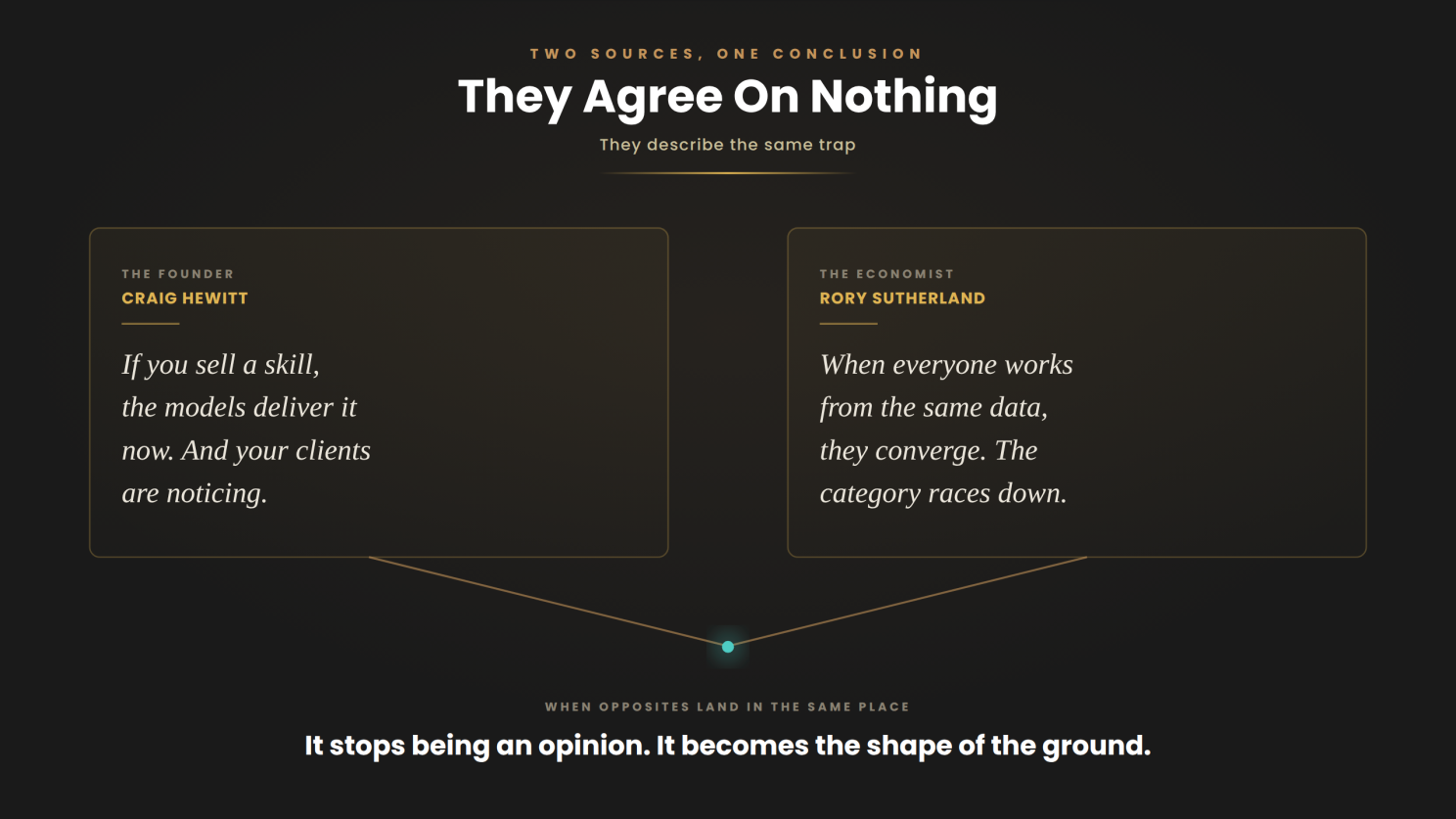
When opposites land in the same place, it stops being an opinion.
It becomes the shape of the ground.
So here's the uncomfortable question.
If that's true, why are so many of us paralyzed?
Struggling to figure out what to do about it?
It's Not What You Think It Is
You're not lazy.
You're not behind. And you're not slow.
Here's what's more forgivable than the story you've been telling yourself.
Somewhere in the last year, you started making a different decision.
It was so subtle you may not have even noticed.
You stopped choosing the move most likely to work. You started choosing the move least likely to be blamed.
Those used to feel like the same move.
Not anymore.
There's a name for this, and it's not cowardice.
When you can't be certain, you optimize for the decision you can defend.
The one that won't get you blamed if it goes wrong.
It's human nature really.
Every instinct you have is tuned to pick the safe-looking move, because for so long the safe-looking move and the right move were the same thing.
But when nobody knows which capability matters in six months, safe and right start pulling apart.
Under pressure, you pick safe.
And here's the cruelty of it.
The exact instinct that protected you your whole career, "don't make the bet you can't defend".
Is now the thing quietly sinking you.
Because the moves worth making right now are the ones you can't defend in advance.
That's not a character flaw.
That's you protecting yourself correctly.
In a game that has quietly started punishing you for it.
There's a second tell, and you already know it if you're being honest.
The tool-chasing.
The new app every week, the subscription you signed up for and used twice.
The nagging feeling that you're falling behind if you're not adding something.
Again, that's not strategy.
That's you reacting to the market to look current, instead of discovering what your client actually needs (and deciding how to deliver it).
You're letting the noise set your agenda.
I say this with zero judgment, because I've done it.
It has a shape, and naming it helps.
But if you feel like you've been reacting instead of prescribing...
Let me take away the two exits people tend to reach for.
- "But I sell a service, not a product, so I'm fine." You're not fine. A service that's a documentable process is exactly what the tools are learning fastest.
- "And this can't touch what I specifically do." Maybe. But that's the thinking both of those two companies would have said about themselves the Friday before they lost $314 billion.
Only the uncomfortable middle answer is true.
It can't do everything you do.
But it's coming for more than you'll want to admit.
And the part it can't reach is smaller, and more specific than you think.
Which is exactly why you need to know exactly where it is.
Here's the relief, because I've been a little heavy on you and you've earned a breath.
I'm going to defend you, because your instinct is half right.
Waiting is smart.
Sitting on your hands about which AI tool to bet on is genuinely intelligent right now.
The tools change monthly.
By now you should already know...
Anyone who tells you they know which vendor wins in eighteen months is guessing.
Don't bet your business on a horse in a race that reshuffles every few weeks.
But don't let "wait on the tools" quietly become "wait on everything."
Those are not the same thing.
There's one move that has nothing to do with which tool wins.
Find what makes you defensible.
Get it out of your head and into a form you can actually use.
That doesn't depend on the vendor race at all.
San Francisco, Beijing, or your own basement.
Doesn't matter.
The thing that makes you un-average is yours either way.
The One Room They Can't Get Into
There is exactly one thing on this entire field that the shared tool cannot reach.
And I want to be careful here, because it's easy to name the wrong thing.
The wrong answer is "what you know."
I know that's the comforting one.
The hard-won understanding locked in your head.
But let's be real.
A sharp operator with a good model can reverse-engineer a shocking amount of what you know, if they know what to look for and what to rule out.
Anything that can be written down can be worked out with enough focus and patience.
So no, the thing in your head is not the moat.
It is the first thing to go.
The thing they can't reach is one level up from what you know.
It's what you think to ask.
The connection you make that nobody else in your category would make.
Point the same commodity tool at the same problem as your competitor.
The difference isn't the tool or the data.
It's the quality of the question you thought to ask.
- That is not stored anywhere.
- It can't be reverse-engineered, because it was never a fact sitting in a file.
- It's the thing you do, live, with everything you have.
A model can write the email.
It cannot decide (faithfully), that this client needs to be led to the third option.
Because it doesn't know what you know about this person.
And even if it did, it wouldn't think to.
It can draft the proposal.
It cannot notice that the real decision happens in a hallway after the meeting.
And quietly reshape the whole approach around that.
That noticing is not information.
It's judgment and creativity, applied in the moment.
That's the room.
Here's What Should Give You Hope
There are people already living in that room.
Completely calm, not worried about any of this.
Because their entire craft is the part that can't be downloaded.
Some of them give their secrets away freely.
Because they already figured out a long time ago that the secret was never the moat.
The moat was the mind that made it.
Rory Sutherland, the behavioral economist I mentioned has a line for this.
He says you can make desirable things, or you can make things desirable.
For the most part, the tools can already make every desirable thing.
Cheaply, instantly, for everyone.
What they can't do is make something mean something.
The tool makes the thing. You decide what it means.
That's the whole difference.
And it's the one thing that doesn't commoditize.
They never think about the tool as a threat.
The same way you don't automatically think about a hammer as a threat.
It's just not in the same category as the thing they do.
You have a room like that too.
You've just never mapped it, because you've been guarding the wrong thing.
Which is the whole problem, and the whole opportunity.
The Map I Promised You
You can't defend a room you can't see.
That's the flaw in everything I've said so far.
I've told you that you have something the tool can't touch.
But if you can't point to it, name it, and see exactly where it lives...
You can't build on it and you can't sell it.
You'll keep letting it sit in your head, invisible.
While the commodity work you can see gets all your attention.
Everything I just walked you through, the blur, the vertigo, the freeze.
All of it comes from not being able to see where you actually stand.
So here is the instrument built to show you.
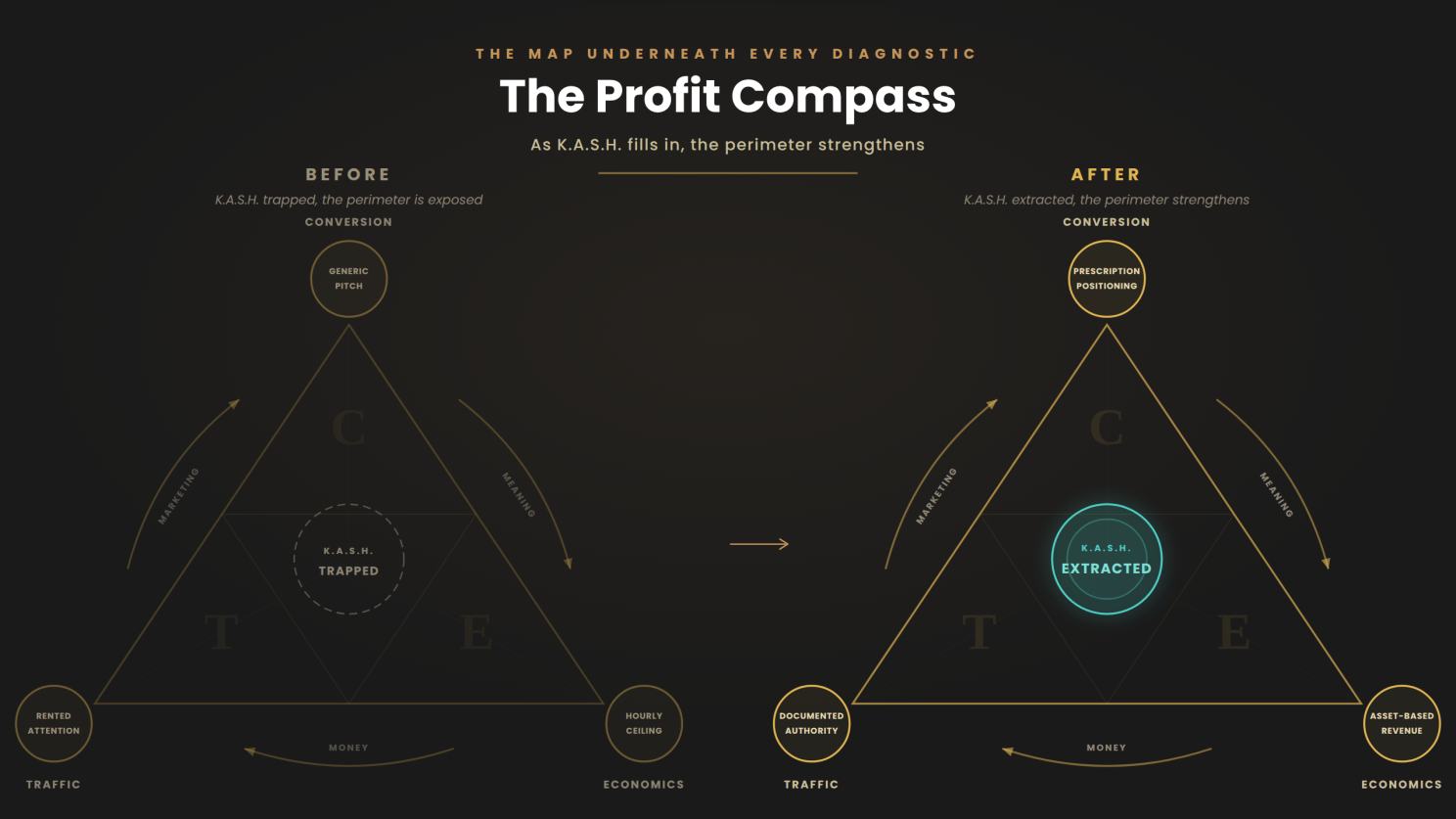
Three points.
They are the entire surface of any business.
Every business on earth lives or dies on these three:
- Traffic: how people find you.
- Conversion: how they decide to work with you.
- Economics: how the money actually works.
And in the center, one thing: your K.A.S.H.
The knowledge, attitude, skills and habits that power the relationships, the judgment, and the work that produces more meaningful results.
Not the stored facts. The living thing that uses them.
That's the compass. It's not a model to admire.
It's an living instrument, and it does two jobs.
First it shows you which parts of your business are still yours, and which are already a commodity.
That's the mirror.
Then it does one thing bigger.
It tells you where to point.
Where to aim your attention, your team, your best thinking, this quarter.
A mirror shows you where you are.
This one also tells you where to go.
For somebody reading this I can already hear the objections spinning up in your head.
"Wait. If I take everything in my head and write it down, aren't I just making myself replaceable? Isn't the fact that it's trapped in my head the thing that protects me?"
No.
You document the commodity layer so that you never have to think about it again.
You get the repeatable four-fifths into a system.
Precisely so that your scarce, expensive, irreplaceable attention is freed up for the one-fifth that can't be.
And the one-fifth is not a hidden file.
It's the clarity of thinking. The quality of judgment.
The connections nobody else would make.
Documenting the rote work is how you buy back the hours to do the only thing the tool can't.
The center of the compass isn't you being turned into a machine.
It's the opposite.
It's the system that handles the machine work.
So you're free to be the one thing a machine will never be.
The Empty Center
Here's what happens when people actually look.
They find the center empty.
The three points are all there.
Traffic, conversion, economics, all running.
But the center is hollow.
The commodity work is still trapped in one head instead of a system.
Eating the hours that should go to the thinking.
And the judgment that's supposed to be your moat is getting spent on rote tasks a tool could do, dulling instead of compounding.
Invisible, unusable, and quietly converging with everyone else's by the day.
That hollow center is the whole exposure.
Not your traffic. Not your pricing.
The empty middle, where your defensibility should be, and isn't.
Honestly, this is a hard thing to look at.
Mapping your own compass usually means admitting that some of the things you were most proud of, some of the work that used to define you, has already slid into commodity.
That stings. It should.
Pretending it doesn't is how you end up on the wrong side of a $314 billion weekend.
What To Do With This, Starting Now
I'm not going to tell you to fix it today.
You can't, and anyone who says otherwise is lying.
Here's the only thing I want you to do this week.
Look at your own compass. Three points, one center.
- Which of the three points is already pure commodity, the stuff anyone with the same tools could do now?
- Then look at the middle. Is your center solid, or is it hollow?
- Is your K.A.S.H. actually documented and usable, or is it trapped in your head where it can't defend anything?
Don't fix it. Just see it.
Seeing it is the entire job this week.
And most people never do even that.
And let me leave you with the reframe that matters most.
Because I think you've been carrying the wrong one.
You don't need to reinvent yourself.
Everyone's telling you to, and they're wrong.
It doesn't have to be that dramatic.
Your expertise isn't the problem. It's more valuable now than it has ever been, precisely because so much else got cheap.
You don't need to become someone new.
You need to become fully deployed.
Fully Deployed means two things.
Get the commodity work out of your head and into a system, so it stops stealing your hours.
Then take what's left, your judgment, your eye for the connection nobody else sees...
And aim it at the place the compass says you're most exposed.
Not once. As a habit.
The tools got cheaper.
Your job is to make sure the one thing they can never copy stops being wasted on work they can.
Next week, we start filling the empty center.
We start with the point that's bleeding the most.
Stay surgical,
Colin
The two videos that had me thinking...
The software founder, on what actually protects a business once AI can do the work: https://www.youtube.com/watch?v=8cSCJtPOkmM&t=2671s
Rory Sutherland, the behavioral economist, on why copying your competitors just makes you converge with them: https://www.youtube.com/watch?v=ceKfXFA3jZU&t=1520s
Frequently Asked Questions
If AI makes tools free, how do businesses stay competitive?
When capability becomes free and every competitor runs the same models trained on the same past, the tools hand everyone the average of what already exists. The edge is no longer the tool or the data. It is the quality of the question you think to ask: the connection you make that nobody else in your category would make, applied live to a specific client's problem. That judgment cannot be reverse-engineered because it was never a fact sitting in a file.
Why is what you know not a moat anymore?
Anything that can be written down can be worked out. A sharp operator with a good model can reverse-engineer a surprising amount of what you know if they know what to look for. So the hard-won understanding locked in your head is the first thing to go, not the moat. The defensible layer is one level up: what you think to ask, the judgment and creativity applied in the moment, which is never stored anywhere.
Does documenting your knowledge make you replaceable?
No. You document the commodity layer, the repeatable four-fifths, precisely so you never have to think about it again and your scarce, irreplaceable attention is freed for the one-fifth that cannot be documented. The valuable one-fifth is not a hidden file. It is the judgment and the connections nobody else would make. Documenting the rote work is how you buy back the hours to do the only thing the tool cannot.
What is the Profit Compass in the Asset Alchemy Method?
The Profit Compass is a diagnostic built on three points that make up the entire surface of any business: Traffic (how people find you), Conversion (how they decide to work with you), and Economics (how the money works). At the center sits your K.A.S.H., the knowledge, attitude, skills, and habits that power judgment and relationships. The compass does two jobs: it shows which parts of your business are still yours versus already a commodity, and it tells you where to aim your best thinking next.
What does an empty center mean for a business?
An empty center is when traffic, conversion, and economics are all running, but the defensible core is hollow. The commodity work is still trapped in one person's head instead of a system, eating the hours that should go to thinking, while the judgment that should be the moat is spent on rote tasks and dulls instead of compounding. That hollow middle, where defensibility should be and is not, is the whole exposure.