When the Phone Stops Ringing and Nobody Can Explain Why
You didn't get a pink slip.
Nobody called to say the contract was over.
Business just...slowed.
The proposals that used to close in two conversations started taking five.
The referrals that came monthly started coming quarterly.
The phone didn't stop ringing all at once.
It just rang a little less.
Then a little less again.
And you can't point to the moment it started because there wasn't one.
If that sounds familiar, stay with me.
Because there's a name for what's happening, and once you see it, you can't unsee it.
The $41.7 Trillion Foundation Problem
Not to build better AI.
To help companies get ready for AI.
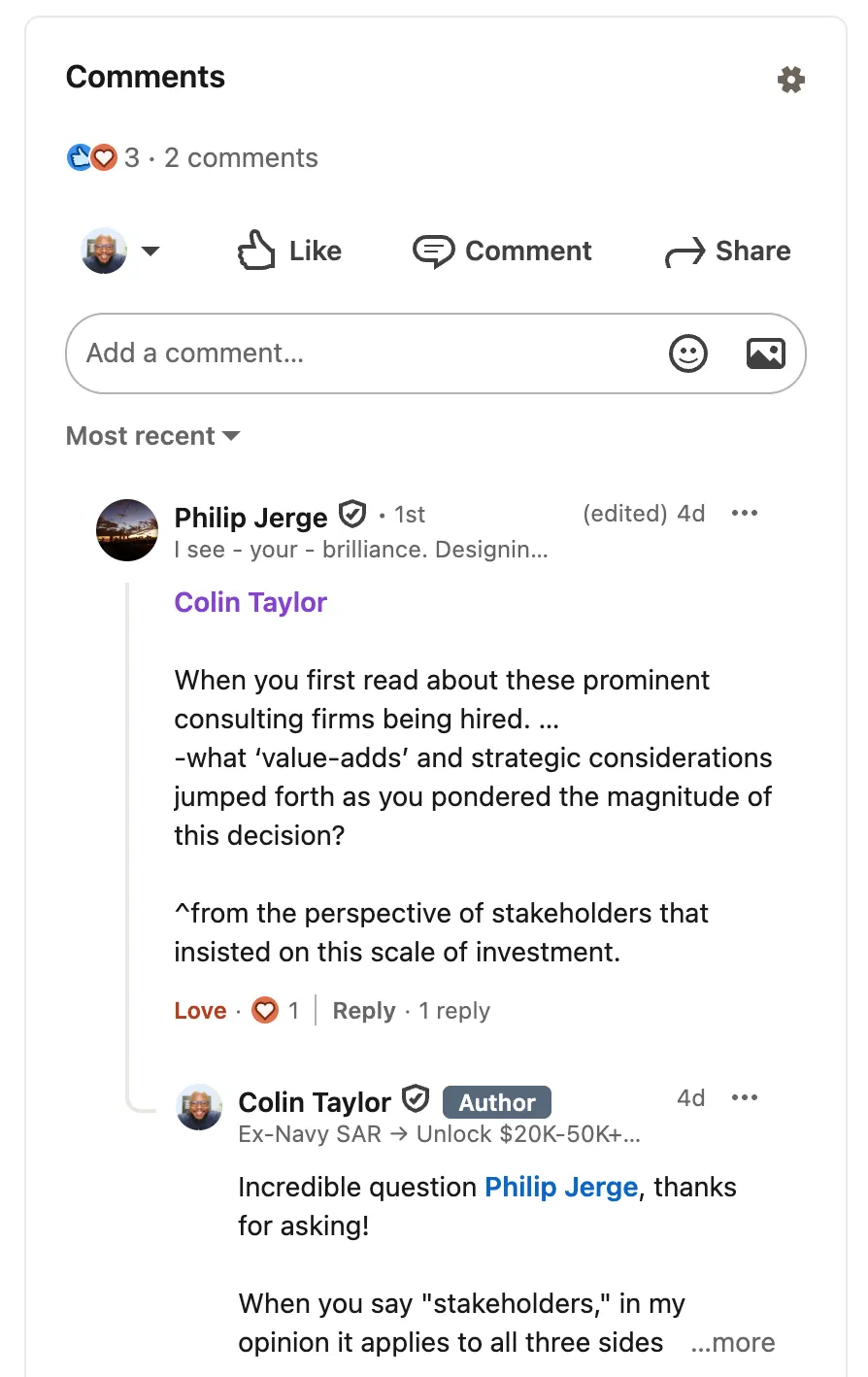
A reader named Philip Jerge commented with a question that prompted me to dig a little deeper than I expected.
He wanted to know what strategic considerations jumped out from the perspective of the stakeholders who insisted on that scale of investment.
So I pulled the thread.
Accenture alone serves over 75% of the Fortune Global 500. BCG and Capgemini each serve roughly two-thirds. McKinsey's reach is similar.
Combined, those four firms touch the vast majority of companies generating $41.7 trillion in annual revenue.
That's OpenAI buying distribution.
The consulting firms buying relevance.
And the enterprise clients proving that the gap between "we bought the AI" and "we can actually use it" is so wide it takes four of the most expensive firms on Earth to bridge it.
But here's what Phil's question actually exposed.
I'd been telling this story at the enterprise level.
OpenAI. IBM. Fortune 500 boardrooms. Consulting firms charging seven figures.
That's the version that makes headlines.
It's not the version that explains why your phone stopped ringing.
Your Prospect Can't Tell the Difference
Everyone's talking about job displacement.
AI replacing workers.
Layoffs.
Automation.
The end of entire industries.
Here's the problem with that framing.
If you're a consultant, a coach, an advisor, a service provider...nobody's firing you.
There's no layoff notice. No automation memo.
Your phone just rings less.
Your proposals sit longer.
Your close rate drops and you can't figure out why.
That's not job displacement.
That's value displacement.
Nobody tells you it's happening. That's the whole point.
The Indistinguishability Problem
At the enterprise level, AI displaces tasks.
IBM proved it.
Their CHRO said the entry-level jobs from two to three years ago?
AI can do most of them.
So they rewrote every job description and moved humans from execution to judgment.
Visible. Measurable. Makes the news.
At your level, AI displaces perceived value.
When a prospect can get a "good enough" version of your strategy deck from ChatGPT in 20 minutes...
They don't stop hiring you because AI took your job.
They stop hiring you because they can't tell the difference between what you deliver and what the tool produces for free.
Your 15 years of pattern recognition.
Your ability to see the thing nobody else sees.
The judgment that only comes from doing this a thousand times.
None of that changed.
But if it lives in your head?
Undocumented, unstructured, invisible...
Then to the buyer standing in front of you, it looks identical to what Claude generated in 30 seconds.
They'll choose the free version. Every time.
Not because it's better.
Because they can't see that it isn't.
The Countdown People Are Missing
Now let's talk about the business owner who doesn't think any of this applies to them.
The chiropractor.
The boutique gym owner.
The specialty retailer.
They're not worried about AI taking their job.
They should be worried about something else.
Their customers are comparing them...
Whether they realize it or not, against AI-curated alternatives, AI-optimized competitors...
And businesses that figured out how to articulate their value in ways that algorithms amplify.
The chiropractor who can't explain why their approach is different from the practice down the street?
They're losing.
Not to AI directly.
To the competitor who documented their methodology.
Structured their patient experience, and made their differentiation visible.
And increasingly, "the practice down the street" isn't down the street.
It's a telehealth provider.
A digital-first wellness platform.
An AI-guided rehab app that showed up in the search results because its value proposition was clear, documented, and structured for discovery.
The brick-and-mortar owner relying on "we've been here 20 years" and word of mouth?
That's not a positioning strategy anymore.
That's a countdown.
$41.7 Trillion Says You Have the Same Problem
Phil's question helped me see the scale of this.
The Fortune 500 is spending millions to solve the foundation problem.
Those four consulting firms collectively reach into $41.7 trillion in annual revenue.
That's not a partnership announcement. That's an admission that the extraction problem is so severe it requires the most expensive consulting infrastructure on Earth to address.
The mid-market consultant is getting commoditized.
Not fired.
Gradually made invisible by tools that approximate their surface-level output for free.
Their proposals compete against prompts.
"Years of experience" means less every month unless it's documented in a way the buyer can see and the tools can't replicate.
The brick-and-mortar business is being outpositioned.
Not by AI itself.
By competitors who made their differentiation visible while everyone else relied on reputation.
Three levels. Three symptoms. Same problem.
The knowledge that makes you valuable is undocumented, unstructured, and invisible to the systems that now determine who gets found, who gets trusted, and who gets paid.
The Invisible Layoff
Nobody fires you.
Nobody cancels your contract.
The market just quietly stops valuing what you're selling at the price you're charging.
Death by a thousand "let me think about it" responses.
That's the invisible layoff.
It's accelerating because AI is compressing the gap between what an expert delivers and what a non-expert can access for free.
The only thing that reopens that gap?
Extraction.
Pull the methodology out of your head.
Document the decision frameworks that make your work different from the generic version.
Structure the pattern recognition so it's visible to buyers before they ever talk to you.
IBM did this for thousands of roles.
Enterprise scale, enterprise budget.
You can do it in 90 days. No McKinsey required.
Your Buyer's Side of the D.I.B.S.
Every D.I.B.S. force is accelerating value displacement. But feel it from the other side for a moment. From the person deciding whether or not to hire you.
Decision Fatigue: they evaluated four AI tools, three competitors, and two DIY options before they ever saw your proposal. If your value isn't immediately clear, you're one more decision they can't make.
Inflationary Pressures: an AI tool costs $20/month. Your proposal costs $5,000. If they can't see the difference, they'll choose cheaper. Not because they're cheap. Because you made it impossible to see (and feel) the gap.
Buyer Bottlenecks: they don't know if they need a better tool, a better strategy, or a better foundation. That confusion doesn't make them choose you. It makes them choose nothing.
Synthetic Content: they've read 50 AI-generated articles on the exact topic you specialize in. They all sound smart. They all sound the same. Your content sounds like that too. Unless your methodology is documented clearly enough to cut through.
Four forces.
All making the invisible layoff faster.
All reversible. If you extract first.
The One Question Worth Sitting With
When was the last time a prospect chose you because of something they could see about your methodology before they ever talked to you?
Not your reputation.
Not a referral.
Not your personality in the room.
Something they found, read, or experienced about how you work...
Before you ever got the chance to explain it yourself.
If you can't answer that, you're not losing to AI.
You're losing to the gap between what you know, and what anyone can see.
That's the invisible layoff.
And it's probably been running longer than you think.
The Part Nobody's Telling You
The reason your methodology is invisible has nothing to do with how hard you work.
Nothing to do with posting more content.
Nothing to do with your marketing.
There's a structural layer between your expertise and the tools that could amplify it.
That layer doesn't exist yet in your business.
Your methodology lives in scattered documents.
Old proposals.
Slide decks from three years ago.
Conversations with clients that nobody recorded.
Maybe a Google Drive folder you haven't opened since last quarter.
That's not a content problem.
That's an infrastructure problem.
And infrastructure can be built.
The Asset Alchemy Method builds it in 90-day sprints: extract the institutional knowledge, document it as defensible IP, and activate the revenue hiding in the assets you've already built.
If you're ready to see what that looks like for your business, book a strategy session.
Stay surgical,
Colin Taylor
Creator of The Asset Alchemy Method
P.S. Phil, if you're reading this, thank you! Your question is the reason this issue exists.
Frequently Asked Questions
What is the invisible layoff and how does it affect service providers?
The invisible layoff is a term coined by Colin Taylor, creator of the Asset Alchemy Method, to describe how AI gradually displaces the perceived value of service providers without a formal termination event. Nobody fires you or cancels your contract. Instead, proposals sit longer, close rates drop, and referrals slow because buyers can no longer distinguish between your 15 years of expertise and what an AI tool produces for free. It is value displacement, not job displacement, and it accelerates when institutional knowledge remains undocumented.
Why is AI making it harder for consultants and coaches to win new business?
AI compresses the gap between what an expert delivers and what a non-expert can access for free. When a prospect can generate a strategy deck from ChatGPT in 20 minutes, they stop hiring consultants not because AI replaced the job, but because they cannot see the difference between the expert output and the AI output. The only way to reopen that gap is to extract, document, and make your methodology visible before a buyer ever talks to you.
How do I protect my business from value displacement by AI?
Protection starts with extraction. Pull the methodology out of your head. Document the decision frameworks that make your work different from the generic version. Structure the pattern recognition so it is visible to buyers before they ever speak with you. The Asset Alchemy Method accomplishes this in 90-day sprints by identifying dormant institutional knowledge, documenting it as defensible intellectual property, and activating it as revenue-generating business assets.
What is the D.I.B.S. Dilemma and how does it accelerate value displacement?
The D.I.B.S. Dilemma describes four market forces eroding business value simultaneously: Decision Fatigue (buyers evaluate too many options before seeing your proposal), Inflationary Pressures (AI tools cost $20 per month while your proposal costs $5,000), Buyer Bottlenecks (confused prospects choose nothing), and Synthetic Content (50 AI-generated articles on your exact specialty make your content indistinguishable). All four forces make the invisible layoff faster, and all four are reversible when you extract and document your methodology first.
How can local businesses compete against AI-optimized competitors?
Local businesses face the same value displacement pattern as consultants, just through a different channel. Their customers compare them against AI-curated alternatives, AI-optimized competitors, and businesses that articulated their value in ways algorithms amplify. The businesses winning are those that documented their methodology, structured their customer experience, and made their differentiation visible. Relying on tenure and word of mouth is no longer a positioning strategy. It is a countdown.