
The AI Hire Everyone Is Making, and the Structural Problem Nobody Is Solving First
I saw this post a few weeks ago.
I didn't respond to it immediately.
Wanted to.
Definitely had a strong reaction.
But I sat with it for a couple of days instead.
And what came out of that is what I want to share with you today.
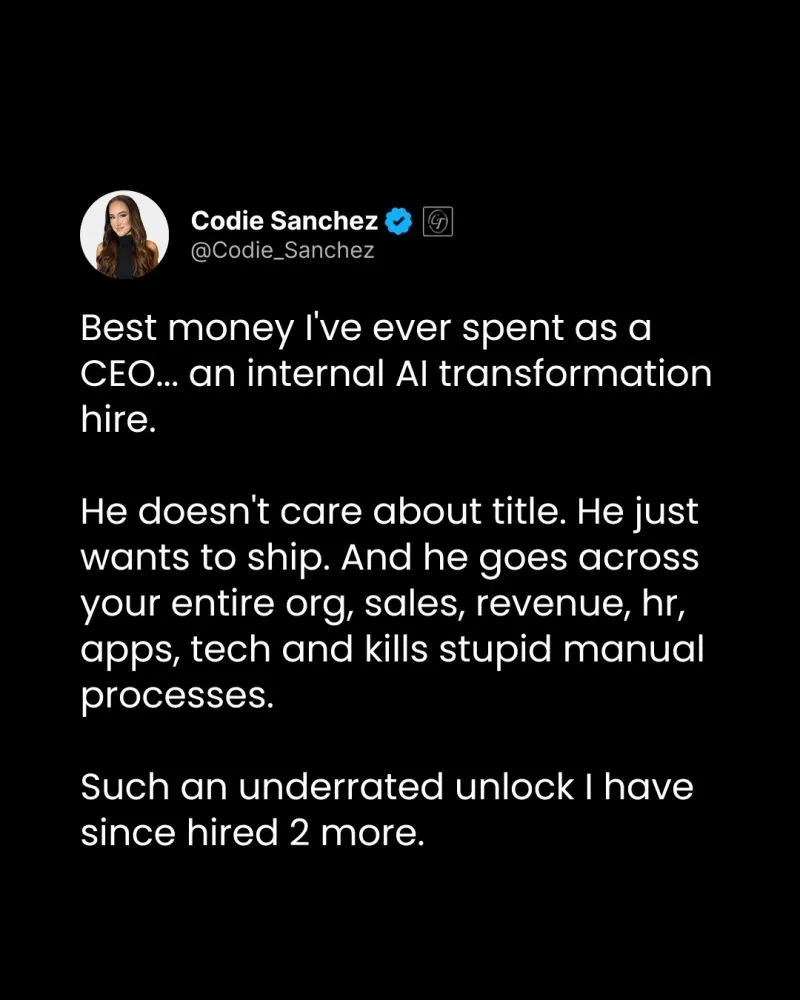
Buried in the comments, past the congratulations, were the people actually doing that job.
Telling a very different story.
One comment in particular stopped me.
Someone replied to a thread about the cognitive load these hires absorb saying...
"Burnout isn't a discipline problem, it's a structural one."
That hits different.
Because it reframes the whole conversation.
That's Not a Job Description. That's a Sin Eater.
It's not about whether the person you hired is tough enough, smart enough, or fast enough.
It's about what you handed them when they walked in the door.
And in most cases, here's the real answer...
Everything that was broken, undocumented, or living in someone's head.
All at once.
That's not a job description.
That's a Sin Eater.
Not trying to be dramatic, but that's what comes to mind.
If you've seen The Bourne Legacy, you know the reference.
Edward Norton tells Jeremy Renner's character that they're the ones who take the moral weight so the institution stays clean.
The community gets absolution.
The sin eater gets buried.
So Why Make the Hire at All?
And look, it's not that the hire is a bad idea.
At this point, you'd be silly not to make it.
The people who can think in systems.
Structure the context of your business so AI can actually use it.
Map how your clients connect to your delivery connect to your operations.
And know when to automate and when to leave it alone.
Those people are extraordinarily valuable.
They're rare.
And the gap between businesses that have someone like this, and those that don't is widening fast.
If you're committed to getting your best work into the world faster, and more profitably, without losing your freedom in the process...
Having someone in your corner who understands this environment isn't optional. It's essential.
Most businesses making this hire are not bringing someone in to transform anything.
They're bringing someone in to absorb every undocumented deficiency they've been avoiding.
And calling it innovation.
This Problem Isn't New. It Just Got Expensive.
I started out in messaging.
Copywriting, positioning, helping businesses get clear on what they actually do, and who it's for.
And to this day, that clarity is at the core of every engagement I take on.
Whether it involves a single landing page or a full AI-enabled system.
But even twenty years ago, the very first question was always the same.
What's the context?
That's what good work requires.
Doing great work requires more.
Now multiply that same need for context by every system, every workflow, every client touchpoint in your business.
When that context isn't documented, every undocumented process, every decision that lives in one person's head, every FAQ that gets answered differently depending on who picks up the phone.
All of it flows downhill to the new hire.
They don't get a map. They get a maze.
And the maze is shifting.
The AI tools themselves, the ones they're supposed to implement, are updating faster than anyone's ability to adapt.
New model releases.
New capabilities.
New pricing.
Weekly.
So now your sin eater is doing three jobs at once.
Archaeologist (digging up what your business actually does).
Architect (designing how AI could improve it).
And translator (explaining all of it to leadership that's already overwhelmed by decisions).
And that's before the approval chains.
The meetings.
The "run it by so-and-so first" culture that turns your fastest person into your most frustrated one.
You hired a builder.
Then buried them in the same bureaucracy that slowed everything down before they got there.
Founder judgment at the top.
AI implementer in the middle.
Team waiting on both.
It caps out faster than you think.
Not because the tools stop working.
Because the human coordination breaks down.

It's Not a People Problem. It's a Sequence Problem.
I'm not saying don't hire an "AI person."
That'd be extremely short-sighted.
But here's the part worth sitting with.
If the reason you're making this hire is because you think the problem is that your business doesn't have enough AI in it...
That's the same thinking that creates the sin eater in the first place.
I'm not pointing fingers when I say this.
But if we're going to fix the pattern, we have to be honest about where it starts.
The problem was never a lack of AI.
It's a lack of documented clarity about how your business actually works, who it serves, and why your approach gets results.
And that gap isn't sitting still.
Your buyers are more overwhelmed than ever.
Your competitors are using the same tools to produce the same content.
So the market gets louder while the signal gets thinner.
Decisions take longer on both sides of the table.
The cost of attention keeps climbing.
All of that is happening right now whether you've documented your methodology or not.
The difference is that the businesses who have done the extraction can respond to these shifts from a position of clarity.
The ones who haven't are just reacting.
And the person you hired to handle the AI side of things is caught in the middle of all of it with no foundation to build from.
That's not a technology gap. That's a knowledge gap.
And until you close it...
Any hire you make is going to spend their time excavating instead of building.
They'll spend six months just trying to figure out what to extract.
And by the time they do, half of it will have walked out the door with whoever left last quarter.
Here's how it usually goes.
Business owner reads about AI transformation.
Hires someone smart. Points them at "everything."
Wonders why, nine months later, the tools are deployed but the results feel thin.
They feel thin because the tools are running on air.
No documented methodology underneath them.
No extracted knowledge feeding them.
No system that compounds.
The AI is working. It's just working on nothing.
What the 13% Do Differently
The businesses that actually get compounding returns from AI share one thing.
They extracted before they implemented.
Documented their methodology first.
Named their frameworks.
Captured the decision logic their best people use instinctively.
Not just what they do, but why they do it that way.
The intent behind the output. The thinking behind the process.
That's what makes it transferable. Not the tool. The thinking.
Then they brought in AI to amplify what was already working.
The difference isn't budget. It isn't just tech literacy.
It's sequence.
The people who can think in systems and connect the moving pieces of your business are rare, and valuable.
But even the best of them can only multiply what's already there.
Hand them a documented methodology and they'll build something that compounds.
Hand them nothing and they'll spend their energy trying to understand what your business does before they can improve any of it.
Extract first.
Implement second.
Compound quarterly.
Do it in that order and your AI transformation hire doesn't become a sin eater.
They become a force multiplier.
And your business gets its best work into the world faster.
Without you in the middle of every decision.
The Question Worth Sitting With
Before you post that job listing or sign that consulting contract, ask yourself one thing.
If this person started Monday, what documented methodology would I hand them?
Not your website copy. Not the pitch deck. Not the "about us" page.
Your actual methodology.
The way you diagnose problems.
The sequence you follow.
The frameworks you've built from decades of pattern recognition that live nowhere except inside your head.
If the answer is "nothing," that's not a hiring problem.
That's an extraction problem.
And it's worth at least $20K to $50K in the next 90 days if you solve it first.
Once it's documented, everything downstream gets faster.
The AI works better.
The team stops bottlenecking through you.
The new hire builds on a foundation instead of excavating for one.
Stop asking your best people to absorb what you haven't organized.
Extract first. Then transform.
Stay sharp,
Colin Taylor
Creator of The Asset Alchemy Method
Frequently Asked Questions
Why do AI hires fail at most service businesses?
AI hires fail because they are handed every undocumented deficiency the business has been avoiding, all at once. Without documented methodology, they spend six months excavating what the business actually does before they can improve any of it. They become archaeologist, architect, and translator simultaneously, while tools update weekly and approval chains slow everything down. The problem is not the person. It is the sequence. Extraction needs to happen before implementation.
What should I document before hiring an AI implementation specialist?
Before hiring an AI specialist, document your actual methodology: the way you diagnose problems, the sequence you follow, the frameworks built from decades of pattern recognition that currently live nowhere except inside your head. The Asset Alchemy Method calls this K.A.S.H. extraction, covering Knowledge, Attitudes, Skills, and Habits. When your new hire starts Monday with a documented methodology in hand, they build on a foundation instead of excavating for one.
What is the correct sequence for AI implementation in a service business?
The correct sequence is extract first, implement second, compound quarterly. The businesses that get compounding returns from AI documented their methodology first, named their frameworks, and captured the decision logic their best people use instinctively. Then they brought in AI to amplify what was already working. Hand an AI implementer a documented methodology and they will build something that compounds. Hand them nothing and they will spend their energy trying to understand what your business does.
How much revenue is at risk from undocumented institutional knowledge?
Undocumented institutional knowledge typically represents $20K to $50K or more in dormant revenue for service businesses in the 6 to 7 figure range. This includes undocumented expertise that could be productized, dormant client relationships that have not been reactivated, and decision frameworks that could be systematized. The extraction itself can happen in 90 days, and solving it before making an AI hire means every dollar spent on implementation compounds instead of evaporating.