In Navy search and rescue swimmer training, they strap you into a helicopter simulator, drop it, and flip it upside down underwater.
Everything goes dark. Water rushes in.
You're inverted, strapped in, disoriented.
The survival protocol starts with one instruction: Watch the bubbles.
They tell you which way is up. If you swim the wrong direction, you drown.
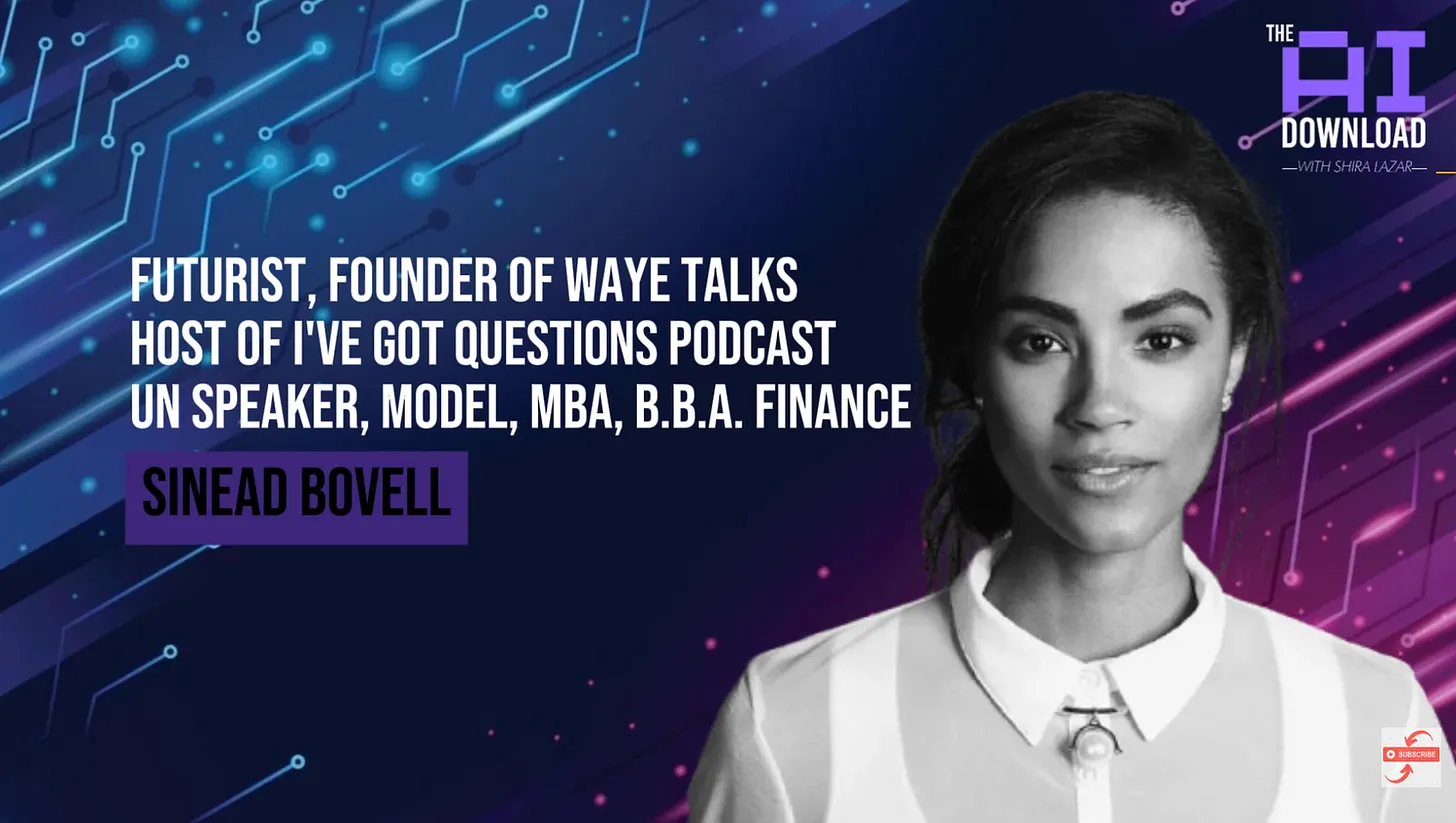
This week, I watched Sinead Bovell (futurist, founder of WAYE, host of I've Got Questions with Sinead) point at the bubbles everyone's missing.
About 15 minutes into her interview on an episode of The AI Download with host Shira Lazar, they said something that made me stop.
"AI isn't replacing workers, it's replacing workflows."
Most people are swimming the wrong direction.
Watch the full interview here. It's worth your time.
Everyone's Worried About the Wrong Thing
Here's what I keep seeing.
"I tried using AI for my job. It couldn't do it. So I think I'm safe."
Or the flip side.
"AI just did in 10 minutes what used to take me 3 hours. I'm screwed."
Both reactions miss what's actually happening.
Here's how she puts it.
"Most jobs AI can't do. It cannot automate workflows from start to finish for most jobs."
You'd think that's reassuring.
It's not.
Because she immediately follows with this.
"Companies know it can't do your job. So that doesn't make your job safe. Companies aren't worried about can AI do your job. They're worried about: are we going to exist?"
That's a fundamentally different question.
Your company isn't running the calculation: "Can we replace Camille with ChatGPT?"
They're running: "What does our company need to BE in an AI-dominated market? And what workflows do we need to GET THERE?"
And here's why that should scare you a little bit.
Having 10+ years of experience doesn't guarantee you're part of the answer.
What Actually Happens When Workflows Get Redesigned
She gives this example.
You're a financial analyst. Been doing it for a decade. You're good at it.
Tomorrow, an AI system handles the analytics part.
Now you're supposed to be more of a strategist. You take AI's analysis and make judgment calls.
Here's the problem.
If you don't have strong judgment skills (if that muscle isn't documented, proven, transferable) you might not be the best person for that role anymore.
Even though you have 10+ years of experience. Even though you were the finance person.
Because the job changed. The workflow changed.
Bovell puts it bluntly.
"The idea that you have experience and you move vertically is starting to unravel. And the idea of having a job title is starting to unravel."
We're moving from jobs to skills. From titles to capabilities. From "I'm a [insert job title]" to "I'm a strategic thinker who understands [domain] and knows how to work with AI systems."
And if that sounds abstract or far away?
It's already happening.
The Documentation Gap That's Costing Careers
When leadership asks "What workflows matter in the AI future?" they're really asking...
"Whose methodology is documented well enough that we can build AI systems around it?"
Because here's the thing about workflow redesign.
Companies aren't just automating tasks. Here's what they're deciding.
- What should humans still do?
- What should AI handle?
- Where does judgment matter?
- Whose judgment do we trust?
And you can't answer those questions if your expertise lives in:
- Your head
- Scattered email threads
- Undocumented Zoom calls
- "That's just how [Name] does it"
Here's what most leaders miss about how AI actually works.
AI systems don't run on gut feel. They need:
- Structured inputs (documented methodologies, clear decision frameworks)
- Measurable outputs (defined success criteria, quality standards)
- Feedback loops (judgment protocols for when AI gets it wrong)
If your expertise can't be articulated clearly enough to brief an AI system (if it's all tribal knowledge and "you just know") the company can't redesign workflows around you.
They'll redesign around someone whose expertise CAN be structured.
Or worse, they'll use generic best practices from the AI's training data instead of your proven approach.
Back to the dunker.
You're upside down. Disoriented. Water's rushing in.
Most people's instinct? Panic and thrash.
The survival protocol:
1. Watch the bubbles. They tell you which way is up.
2. Find your breathing device. It's the first thing you grab. Without it, nothing else matters.
3. Work your way free. Unbuckle, orient, move deliberately.
4. Egress. Follow the procedure. Surface.
Here's what kills people: grabbing for the wrong thing first.
It's mind boggling to see this happen in real time.
They reach for gear. They try to save equipment. They forget the breathing device.
If not for the instructors, some people would've drowned...
Still holding onto something that doesn't keep them alive.
Workflow Redesign is The Dunker.
Your company just got flipped upside down.
Everything's inverted. Most people are disoriented.
The bubbles are telling you: it's not about "Can AI do my job?" That's swimming sideways.
The bubbles are pointing up: "What workflows matter in the AI future? Whose documented methodology do we build around?"
And here's the question that determines if you survive.
What's your breathing device?
What are the key assets and methodologies that keeps you alive when everything's upside down?
- The client transformation framework that generates 80% of your results?
- The decision matrix you use for every strategic call?
- The onboarding process that turns confused buyers into raving clients?
- The diagnostic questions that surface $20K problems in 15 minutes?
If those only exist in your head or scattered across 47 Google Docs, you don't have a breathing device.
You have gear you can't reach when you're underwater.
Leadership is asking "What workflows matter?" right now.
The people who surface?
They stay calm. Get oriented. Then grab their breathing device first.
Because they documented their methodology before the dunker flipped.
Put another way: They're not asking "How do we automate what we do?"
They're asking...
"What should we do differently now that AI exists?"
And if your proven approach isn't captured as a reusable asset?
You're not part of that answer.
Why "Just Learn AI" Fails Without This Foundation
There's a moment in the interview where Bovell visibly pushes back on the most common, and misleading AI guidance out there.
People hear about disruption and think...
"AI can't do my job perfectly, so I'll just pick up some AI skills and I'll be fine."
Her response is the wake-up call:
"Without understanding the nuance, you may just double down on learning AI specifically for your role and not zoom out and see the bigger picture."
And that "bigger picture" is exactly where most teams fail.
Here's what it looks like in real life.
Week 1: Everyone's hyped. ChatGPT is generating some copy, reports, ideas and outlines.
Week 3: Leadership asks, "Okay...but is any of this actually good?"
Week 5: Teams realize they've automated chaos. There's no shared definition of quality, no strategy, and no framework guiding the outputs.
Because here's the truth.
- You can't write effective prompts without knowing your methodology.
- You can't evaluate AI outputs without documented quality standards.
- You can't correct AI when it's wrong if you can't articulate why it's wrong.
This is why "just learn prompt engineering" fails.
The best prompts don't come from clever syntax.
They come from people with documented frameworks.
They're not guessing. They're translating their proven process into AI instructions.
Yes. Learn how to use AI tools.
But more importantly:
- Learn how to bring judgment to AI outputs.
- Learn how to articulate why an AI recommendation is right or wrong.
- Learn how to know when to override the system.
And here's the part people don't talk about enough.
You can only do those things if you have documented frameworks for HOW you think.
If you can't explain your decision-making process, you can't evaluate AI's decision-making process.
If you haven't captured what "good" looks like in your domain...
You can't tell if AI is producing "good"...or "good-sounding garbage."
This is the asset gap AI just exposed.
The professionals who did document their methodologies, their decision frameworks, their client processes, their operating logic, those are the people companies are redesigning workflows around.
Everyone else?
They're being designed out.
Why Most AI Strategies Just Automate the Past
There's a moment in the interview where Bovell talks about Hollywood.
The "obvious" future everyone's predicting: AI creates digital twins of actors. Boom, no more need for real actors.
Her take?
"That is a very linear way to think about the future. Let's take what we do and just do the exact same thing but automated. Any business, any company, any creator that is thinking about the future through that lens doesn't understand disruption."
This applies directly to your business.
If your AI strategy is "Let's automate what the marketing team does", you're thinking linearly.
You're asking AI to do old workflows faster.
The companies winning are asking:
- "What workflows should exist that we couldn't do before AI?"
- "How do we turn our proven methodologies into proprietary AI-enhanced systems?"
That might buy you 12 to 18 months.
But when your competitor figures out how to do something different (something that wasn't possible before AI) your "efficient automation of the old workflow" becomes irrelevant.
Three Questions That Determine If You Survive the Redesign
1. Is your expertise documented or trapped?
If someone asked you to explain your decision-making framework right now (not just what you do, but how you know when approach X works better than approach Y) could you pull up a document?
2. Can you prove your methodology works?
Not "I've been doing this for 10 years."
Can you point to documented client outcomes from specific things you did?
3. If AI automated the tactical parts of your job tomorrow, what judgment layer would you bring?
And can you articulate that judgment layer in a way leadership can understand and build around?
That's the difference between:
"We need Camille in the new workflow because her judgment is irreplaceable"
And:
"Camille's expertise was never documented, so we'll just train the AI on generic best practices instead."
Next Week: The Client Who Had Their Assets Documented When the Dunker Flipped
I'm showing you something I usually don't share publicly.
A client who faced the exact workflow redesign question Sinead describes.
They had to answer it under pressure.
The difference?
We built them a RAG (Retrieval-Augmented Generation) system trained on their documented expertise BEFORE the redesign conversation started.
And it gets smarter the more they use it.
So now they have an AI system that can demonstrate their methodology in action.
Their competitors are still figuring out how to use ChatGPT.
My client is leveraging an AI trained on their proprietary frameworks and multiplying their results.
I'll walk you through:
- What the "before" state looked like (scattered tribal knowledge, vulnerable to automation)
- The inflection point when the workflow redesign question came
- How we documented assets first, then built AI around them
- The exact system we created (and why it worked)
Because here's what I've learned building AI systems for clients:
The companies winning aren't the ones with the best AI tools.
They're the ones whose expertise was documented before the tools arrived.
When the workflow redesign comes (and it's coming) you want to be the methodology they build around.
Not the job function they're trying to automate away.
More next week.
Stay sharp!
Colin Taylor
Creator of The Asset Alchemy Method
P.S. It takes hard work to get this right. But the end result is invaluable to your business and client outcomes. There are also some very real trade-offs you need to be aware of so you don't overcomplicate the process (ask me how I know). More on that next week!
Frequently Asked Questions
Is AI going to replace my job?
AI can't automate most jobs from start to finish. But that doesn't make any role safe. Companies aren't asking whether AI can do your job. They're asking what workflows they need in an AI-dominated market, and whose documented expertise they should build those workflows around. The professionals who survive workflow redesigns are those whose methodology is captured, proven, and transferable, not just experienced.
Why is documenting expertise important for AI readiness?
AI systems need structured inputs, measurable outputs, and feedback loops to function effectively. If your expertise exists only in your head, in scattered emails, or as tribal knowledge, companies can't redesign workflows around you. The Asset Alchemy Method helps service providers extract and document their institutional knowledge so it becomes a strategic asset that AI systems can amplify rather than replace.
What is the biggest mistake businesses make with AI implementation?
The biggest mistake is thinking linearly, trying to automate existing workflows faster instead of asking what new workflows should exist. Companies that simply automate old processes using AI don't understand disruption. The companies winning are those asking what workflows should exist that weren't possible before AI, and building those around their proven, documented methodologies.
Why does learning prompt engineering fail without documented methodology?
The best prompts don't come from clever syntax. They come from people with documented frameworks who can translate their proven processes into AI instructions. Without documented methodology, you can't write effective prompts, evaluate AI outputs against quality standards, or correct AI when it's wrong. The Asset Alchemy Method addresses this by making methodology extraction the first step before any AI implementation.