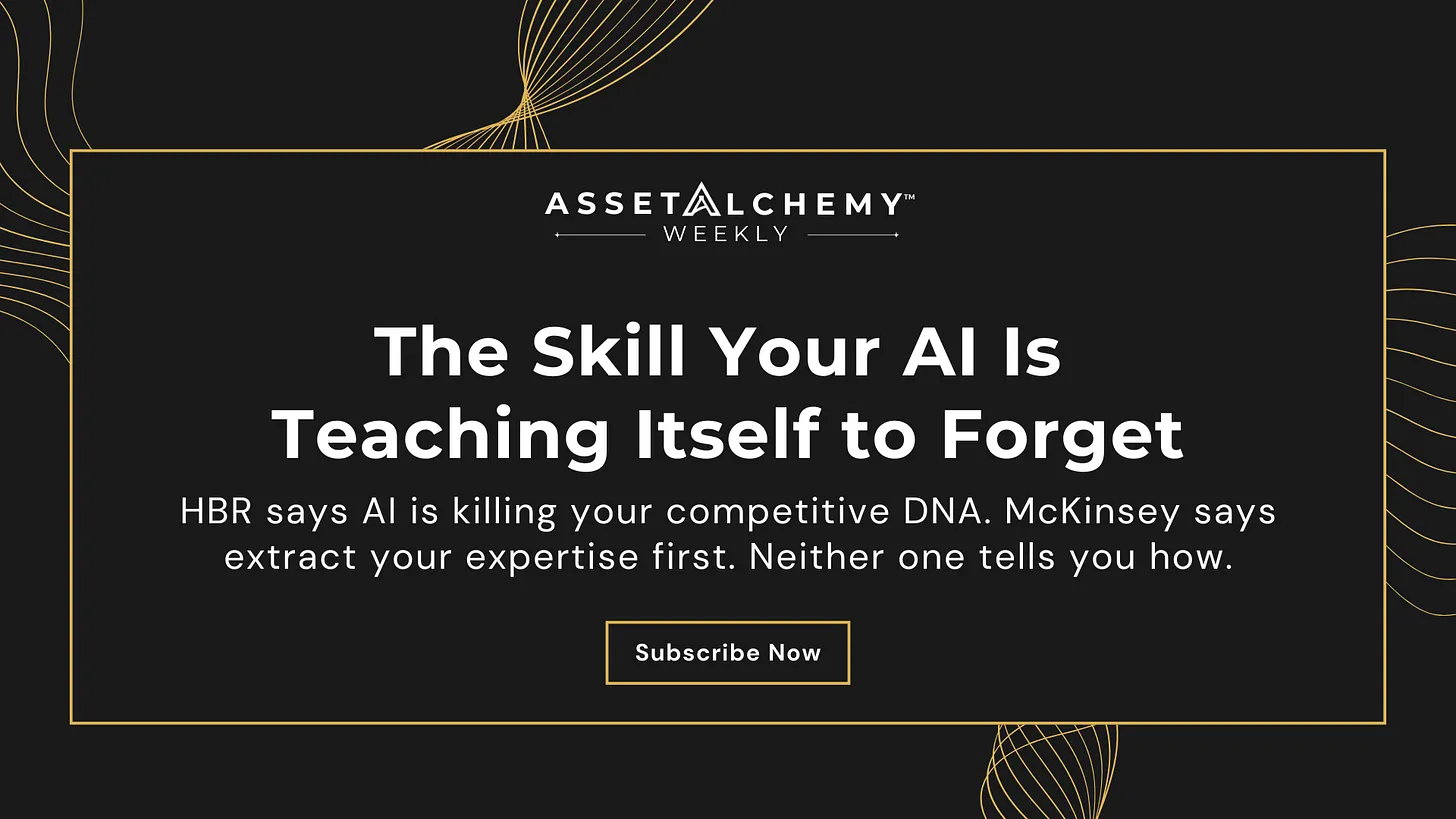
Harvard Business Review and McKinsey Described the Same Problem. Neither Named Who Fixes It.
Two weeks ago I showed you the Documentation Deficit: the CEO coach with 120 blog posts, a published book, and a 19-out-of-25 Synthetic Content exposure score.
Invisible despite decades of expertise.
Last week I introduced you to the Sin Eater: the person inside a company who absorbs the consequences of everyone else's decisions, and why the sequence of your AI hires matters more than the people.
This week, Harvard Business Review connected both problems in a single warning.
And it's worse than either one alone.
What HBR Actually Said
On April 1st, Graham Kenny and Ganna Pogrebna published a piece in HBR titled "Don't Let AI Destroy the Skills That Make Your Company Competitive."
AI doesn't just automate tasks. It erodes the institutional capabilities that made your company worth automating in the first place.
Three risks, specifically.
First, skill atrophy.
When employees rely on AI instead of developing judgment, the judgment disappears. Not overnight. Gradually. The way a muscle weakens when you stop using it, except nobody notices because the AI output still looks competent.
Second, decision opacity.
Organizations bury important decisions inside systems nobody fully understands. The logic that used to live in a person's head now lives in a prompt chain nobody documented. When something breaks, nobody knows why it worked in the first place.
Third, weakened collaboration.
The informal interactions that build trust and shared understanding, the hallway conversation, the working lunch, the "let me show you how I actually do this" moment, get replaced by asynchronous AI workflows. The output looks better on screen. The thinking behind it gets thinner every week.
Here's the line that jumped out at me.
AI can "kill the individual DNA of an organization by cleaving to the generic standard."
Read that again.
The tool you bought to amplify what makes you different is actively training your business to sound like everyone else.
The Word McKinsey Invented for What You're Losing
A few weeks before HBR published that warning, McKinsey published something that, read alongside it, functions as the prescription.
They coined a term: agentification.
Not "automation." Not "AI transformation."
Agentification: the deliberate process of extracting tacit knowledge from experienced individuals, structuring it, and embedding it into systems that can scale it.
Automation says: "This task can be done by a machine."
Agentification says: "This person's judgment can be captured, documented, and multiplied, but only if someone extracts it first."
McKinsey described a global manufacturer that mapped one executive's pricing decisions, the logic, the exceptions, the judgment calls nobody wrote down, into AI workflows.
The result wasn't that AI replaced the executive.
The result was that the executive's expertise operated across the entire business instead of being bottlenecked in one person's calendar.
That's the difference between using AI to replace judgment and using AI to extend it.
But here's what McKinsey didn't say, and what HBR's warning makes obvious.
If you deploy AI before you extract that judgment, the AI doesn't extend anything.
It averages.
It defaults to the generic standard.
And the longer it runs that way, the more your organization forgets what made its judgment distinctive in the first place.
HBR described the disease. McKinsey described the surgery.
Neither one mentioned who's supposed to do the extraction.
What This Means If You Run a Service Business
The HBR piece is aimed at enterprises.
You're a consultant, a coach, an agency founder, a fractional executive.
Your competitive advantage isn't your website or your content calendar.
It's the pattern recognition you've built over 10, 20, 30 years of doing the work.
The way you diagnose a client's real problem in the first 15 minutes of a call.
The framework you use to prioritize, the one you've never written down because it lives in your instincts.
The specific sequence you follow when onboarding a new engagement that makes clients say "nobody's ever done this before."
That's your institutional DNA.
And every time you hand a task to AI without first documenting the logic behind how you do it, you're training the AI on generic patterns instead of yours.
The output looks professional.
It sounds competent.
But it doesn't sound like you.
And over time, you start losing track of why your version was better.
That's the first erosion.
The second one is quieter.
Even the expertise you have documented may be calibrated to a buyer who no longer exists.
Your clients' needs, desires, and decision-making patterns are shifting underneath you, shaped by the same forces reshaping everything else.
The assumptions you built your frameworks on three years ago may not match how your best prospects evaluate, compare, and commit today.
You're drifting in two directions at once.
AI is flattening your methodology into something generic. And the methodology itself may be aimed at a target that's already moved.
That's not a content problem. That's a foundation problem.
The Three-Week Test
Here's a simple diagnostic.
Look at the last three weeks of content, proposals, or client deliverables you produced with AI assistance.
Can you identify what's yours versus what's generic?
If you can't tell the difference anymore, the erosion has already started.
And if your clients can't tell the difference, that's the Documentation Deficit from two weeks ago becoming a revenue problem.
What the 13% Are Doing Differently
One client documented her diagnostic framework, the 15-minute call she's done 400 times, before deploying AI on top of it.
The difference in output quality was immediate.
Because they're sequencing correctly.
They extract first.
Document the judgment, the frameworks, the decision logic, the Knowledge, Attitudes, Skills, and Habits that represent decades of accumulated expertise.
Then they deploy AI on top of that documented foundation.
The AI doesn't average their expertise.
It amplifies it.
Because it has something specific to amplify instead of defaulting to the median.
McKinsey charges seven figures for what they're calling "agentification."
The extraction itself, the part that actually creates the asset, can happen in 90 days if you know what you're looking for.
The question isn't whether to use AI.
The question is whether your AI knows who it's working for.
If your output feels thinner even though the volume is higher, that's not a content problem.
It's an extraction problem.
And now you know what to call it.
Stay sharp,
Colin Taylor
Creator of The Asset Alchemy Method
P.S. McKinsey described a manufacturer whose single executive's expertise was bottlenecked in his calendar. When they extracted and systematized it, the whole company got smarter. You don't need McKinsey's budget for that. You need someone who knows how to ask the right questions in the right order. That's what Phase 1 was built for.
Sources
Kenny, G. and Pogrebna, G. "Don't Let AI Destroy the Skills That Make Your Company Competitive." Harvard Business Review, April 1, 2026. https://hbr.org/2026/04/dont-let-ai-destroy-the-skills-that-make-your-company-competitive
"How to Build Businesses Faster and Better with AI." McKinsey and Company, March 2026. https://www.mckinsey.com/capabilities/business-building/our-insights/how-to-build-businesses-faster-and-better-with-ai
Gartner survey of 782 infrastructure and operations leaders: only 28% of AI projects fully succeed and meet ROI expectations. April 7, 2026. https://www.gartner.com/en/newsroom/press-releases/2026-04-07-gartner-says-artificial-intelligence-projects-in-infrastructure-and-operations-stall-ahead-of-meaningful-roi-returns
Frequently Asked Questions
What is AI skill atrophy and why should business owners care?
AI skill atrophy occurs when employees rely on AI instead of developing judgment, causing the judgment to gradually disappear. Harvard Business Review warned in April 2026 that AI can kill the individual DNA of an organization by defaulting to generic standards. For service businesses, this means the pattern recognition built over 10 to 30 years of doing the work slowly erodes as AI produces competent-looking output that does not sound like you and does not carry your methodology.
What is agentification and how is it different from automation?
Agentification is a term coined by McKinsey in March 2026 to describe the deliberate process of extracting tacit knowledge from experienced individuals, structuring it, and embedding it into systems that can scale it. Automation says a task can be done by a machine. Agentification says a person's judgment can be captured, documented, and multiplied, but only if someone extracts it first. McKinsey documented a global manufacturer that mapped one executive's pricing decisions into AI workflows, allowing that expertise to operate across the entire business.
Why do most AI implementations fail for service businesses?
Most AI implementations fail because they deploy tools before extracting the institutional knowledge those tools need as a foundation. According to Gartner, only 28% of AI projects fully succeed and meet ROI expectations. When AI runs without documented methodology underneath it, it defaults to generic patterns instead of amplifying what made your business distinctive. The result is output that looks professional but sounds like everyone else.
What should I do before deploying AI in my business?
Before deploying AI, extract and document your institutional knowledge: the diagnostic frameworks, decision logic, client onboarding sequences, and pattern recognition that represent your competitive advantage. The Asset Alchemy Method calls this K.A.S.H. extraction, covering Knowledge, Attitudes, Skills, and Habits. The businesses that get compounding returns from AI extracted before they implemented. The extraction itself can happen in 90 days if you know what you are looking for.