A Story Every Business Leader Needs to Read Before Implementing AI Into Their Business
This morning, someone just like you is about to sign an AI contract.
They believe it will save their business money.
Instead, they are about to lose everything that matters.
Customers, employees, and the competitive edge they spent years building.
Maybe it will not be $99 million like what just happened to Klarna.
But for a $500K business, losing $50K hurts just as much. For a $2M company, a $200K mistake can be devastating.
Here is the question that could save you.
"Does this strengthen the 20% that drives 80% of my results?"
Most will not ask it.
And that is exactly why they will fail.
The CEO Who Had to Eat His Words
Last month, Sebastian Siemiatkowski did something most CEOs would rather die than do.
He admitted he was wrong. Publicly.
"Cost unfortunately seems to have been a too predominant evaluation factor... what you end up having is lower quality." (Yahoo Finance, 2025)

This was not some startup founder scrambling for investors.
This was the CEO of Klarna.
The $6.7 billion fintech star that had become Silicon Valley's AI poster child.
The same leader who, just 12 months earlier, was being splashed across TechCrunch covers, celebrated by investors.
Who announced his AI chatbot was doing the work of 700 humans.
Who promised $40 million in "profit improvement" while handling 2.3 million customer conversations. (Klarna Press Release, February 27, 2024)
12 Months of AI "Success" That Led to $99M in Losses
Here is the timeline of how everything played out.
February 2024: Klarna launches AI chatbot, reduces customer service time from 11 minutes to under 2 minutes. Industry applauds.
Throughout 2024: Strategic workforce reduction from 5,527 to 3,422 employees (40% decrease. Every third person, gone).
Q1 2025: Despite $40M in promised savings, actual losses explode from $47M to $99M. (In all fairness, not all losses were due to this AI failure.)
May 2025: Siemiatkowski quietly starts hiring humans back.
Wanna know the craziest part?
While Klarna's execs celebrated their AI "breakthrough," the real numbers told a different story.
Someone had to walk into that boardroom and explain how their "success" had imploded and $47 million became $99 million.
Why This $99M Mistake Could Happen to You
I wrote about this exact dynamic in December 2024 in "The AI Blindspot That's Costing Your Clients Big (And Why They'll Blame You For Missing It)."
In that piece, I outlined how service providers needed to help clients navigate AI transformation strategically, by focusing on value creation rather than just cost optimization.
Klarna's expensive lesson proves exactly why that strategic approach matters.
Here is where it gets interesting...
We have seen this movie before.
1995: "The internet is just for academics." Result: Entire publishing industry decimated.
2007: "Smartphones are just fancy phones." Result: Nokia lost 46.3% of market value in 3 years.
2010: "Streaming is just a fad." Result: Blockbuster, gone.
The pattern is always the same.
New technology emerges. Leaders optimize for the wrong metrics (or ignore it entirely). They mistake efficiency for effectiveness. Competitors who understand the real game take over.
Klarna just gave us one of the most expensive case studies yet.
The Test Klarna Failed (And Why You Cannot Afford To)
Every decision Klarna made seemed logical: Reduce costs. Increase efficiency. Automate repetitive tasks.
But they failed what I call The Profit Compass Test.
You are probably already familiar with the 80/20 rule. Perry Marshall expanded on this in a powerful way in his book "80/20 Sales and Marketing."
After reading it years ago, I developed the Profit Compass as a simplified way to make these principles stick when working with clients.
This framework works whether you are running a $300K consulting practice or a $300M enterprise. The mathematics of business concentration remain the same.
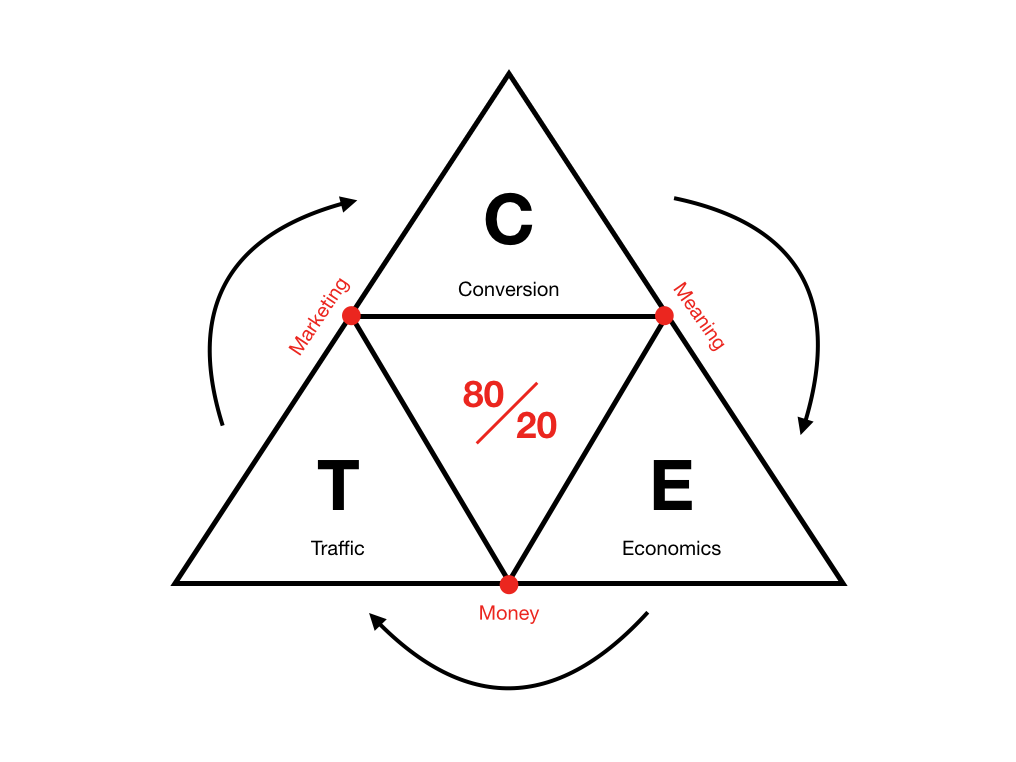
The Profit Compass Framework
Every successful business operates on three critical points that determine profitability.
T (Traffic): 20% of sources = 80% of quality prospects
E (Economics): 20% of offers = 80% of profit margins
C (Conversion): 20% of touchpoints = 80% of revenue
The 3 Warning Signs You Are Next
Think of these intersection points like the vital organs of your business. Cut the wrong one, and everything flatlines.
Klarna essentially performed surgery on their heart while ignoring the warning that their vital signs were crashing.
The magic happens where these points connect.
Creating three critical business functions that align with the Asset Alchemy Method:
Marketing (Traffic + Conversion) = CLARITY
Your ability to attract the right prospects AND convert them into buyers. This is Phase 1 of Asset Alchemy, gaining clarity on which traffic sources and conversion touchpoints are in your critical 20%.
Meaning (Conversion + Economics) = CONFIDENCE
The value perception that justifies premium pricing. This is Phase 2 of Asset Alchemy, building confidence in your positioning so you can command premium rates.
Money (Economics + Traffic) = CONTROL
The sustainable profit engine that funds growth without personal dependency. This is Phase 3 of Asset Alchemy, achieving control over your revenue generation.
Klarna's Fatal Error? They optimized for cost (trying to reduce Money) without protecting the Marketing and Meaning intersections that actually create sustainable profit.
They asked: "How can we cut costs fastest?"
Instead of asking: "Does this optimize our proven 20% that drives 80% of results?"
That single question difference cost them $99 million.
The Three Ways AI Is Quietly Sabotaging Your Most Profitable Assets
The beauty of the Profit Compass is that it works whether you are generating $500K or $50M in revenue. The critical 20% exists at every level.
Right now, AI commoditization is systematically attacking all three compass points.
Traffic Flood: Your proven traffic sources are drowning in AI-generated noise. The same channels that used to deliver your best prospects are now flooded with synthetic content, making it more expensive to reach the people who actually buy from you.
Conversion Damage: AI chatbots are destroying the human connection that drives sales. As Klarna discovered, their AI "lacked empathy," had "limited functionality," and "customer dissatisfaction surged because the AI could not handle complex issues." Trust beats Automation.
Economics Trap: The race to AI efficiency is a race to the bottom. Klarna's $40 million in promised "savings" became $99 million in actual losses because optimizing for cost destroyed the value perception (and the client relationships that sustain it).
What Other CEOs Will Not Admit Publicly (But Confess in Private)
I have watched this exact sequence play out across three different industries in the past 18 months.
Leaders get seduced by AI efficiency and ignore the fundamentals.
The CFO rubs his palms together celebrating cost reductions.
Then the customers and employees start disappearing.
Klarna is not alone in this expensive education, and other tech leaders are privately admitting what they will not say publicly.
In a moment of transparency, Siemiatkowski pulled back the curtain.
"I talk to them [other Silicon Valley CEOs] in private rooms and it is like, 'Oh my God, the jobs are gone'... I feel that is dishonest." (Semafor, June 2025)
This is what they are saying behind closed doors while telling shareholders everything is fine.
And the data backs this up. IBM research found only 24% of AI projects deliver promised ROI. 55% of companies that executed AI-driven workforce reductions now regret their decisions. Strategic AI implementations continue failing because they optimize for the wrong things in the wrong order.
The Asset Alchemy Alternative
While Klarna burned $99 million learning this lesson, there is a different approach that protects your critical 20% while leveraging AI effectively.
Most businesses are sitting on $20K-$50K+ in untapped revenue within the three compass points they already control.
The leaders who want to avoid becoming cautionary tales can run one specific assessment that identifies which Traffic sources, Economics drivers, and Conversion touchpoints are actually in their critical 20%, BEFORE making any AI implementation decisions.
It takes 45 minutes. It could save your business.
Most will skip it because it seems too simple.
Your 3-Question Protection Plan
Before any AI implementation, ask these three questions.
1. Does this optimize my proven 20% in Traffic, Economics, or Conversion?
2. Am I chasing cost savings that could damage the 20% that actually works?
3. Will this strengthen assets I already control, or create new dependencies?
If You Read Nothing Else, Remember This
Before any AI decision, ask: "Does this strengthen my proven 20%?"
That question alone could save you six figures plus six months of losses.
Your Next Step
Now that you have seen the Profit Compass fundamentals that would have saved Klarna $99 million, I have created the complete methodology that identifies your critical 20% before you make costly AI decisions.
The Asset Alchemy Method Overview shows you the exact steps to think through when you are serious about how to incorporate AI into your business without breaking it.
It is the same framework that can prevent you from joining the 76% of AI projects that fail.
Do not become the next $99 million case study.
Stay surgical,
Colin Taylor
Creator of The Asset Alchemy Method
Frequently Asked Questions
What happened with Klarna's AI implementation?
Klarna launched an AI chatbot in February 2024 that reportedly did the work of 700 humans, promising $40 million in profit improvement. They reduced their workforce by 40% over the following year. By Q1 2025, losses had exploded from $47 million to $99 million, and CEO Sebastian Siemiatkowski publicly admitted that cost had been "too predominant" an evaluation factor, resulting in lower quality. The company quietly began rehiring humans. This case study illustrates the systems gap that makes AI implementation catastrophically expensive when leaders optimize for cost without understanding what actually drives revenue.
What is the Profit Compass Framework?
The Profit Compass is a simplified framework built on the 80/20 principle showing how every business operates on three critical points: Traffic (20% of sources drive 80% of quality prospects), Economics (20% of offers drive 80% of profit margins), and Conversion (20% of touchpoints drive 80% of revenue). Where these points intersect creates Marketing (Clarity), Meaning (Confidence), and Money (Control), which align directly with the Asset Alchemy Method phases. Klarna failed by optimizing for cost while destroying the intersections that create sustainable profit.
How do I know if my business is at risk of making the same mistake as Klarna?
Watch for three warning signs: your proven traffic sources are drowning in AI-generated noise (Traffic Flood), AI automation is replacing the human connections that drive sales (Conversion Damage), and you are chasing efficiency savings that erode your value perception (Economics Trap). If any of these apply, run the three-question protection plan before making further AI decisions. Leaders who recognize problems without taking action end up with expensive awareness instead of competitive advantage.
What should I do before implementing AI in my business?
Ask three questions: Does this optimize my proven 20% in Traffic, Economics, or Conversion? Am I chasing cost savings that could damage the 20% that actually works? Will this strengthen assets I already control or create new dependencies? Most businesses are sitting on $20K-$50K+ in untapped revenue within the compass points they already control. Identifying your critical 20% takes roughly 45 minutes and could save your business from joining the 76% of AI projects that fail. Understanding why seeing the battlefield matters is the first step toward strategic AI implementation.