The Question That Silenced a Room of Successful Entrepreneurs
"Can you trace exactly how your last five biggest deals actually started?
Not the sanitized version in your CRM. Not how you think it should work.
The actual, messy sequence of events that led each prospect from stranger to signed contract?"
Three years ago during a presentation, I asked twelve successful entrepreneurs this exact question.
At least half of their hands shot up confidently. Then I followed up...
"How many have actually verified this in the last six months?"
Every single hand went down.
That silence changed how I think about business systems entirely.
Confidence in our systems and actual knowledge of how they work? Two completely different things.
Most entrepreneurs can't trace their deals effectively because they're too busy delivering results to systematically investigate the gap between how they think their business works and how it actually works.
This systems gap is making AI implementation catastrophically expensive.
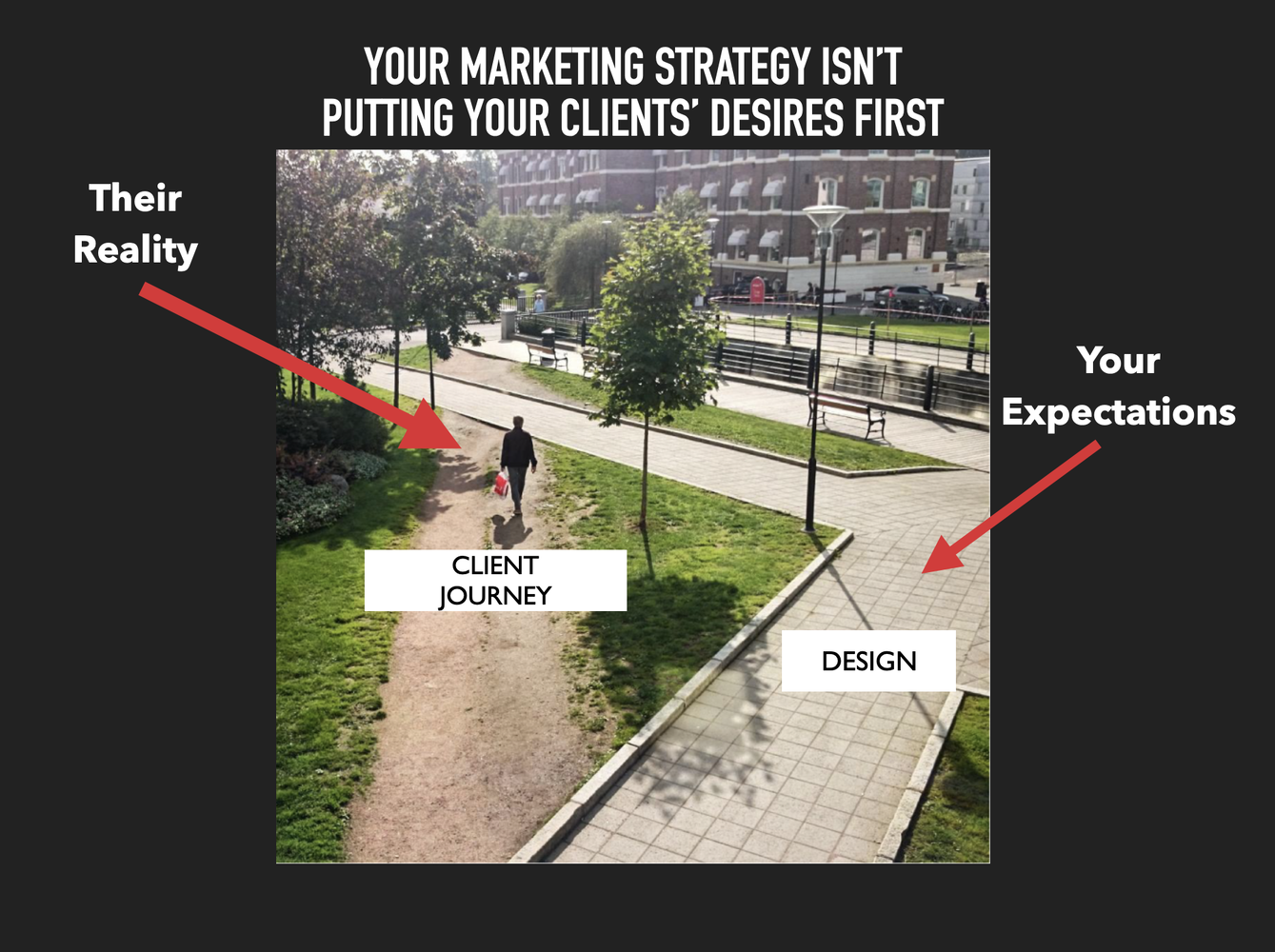
The Dirt Path Discovery: Why Your Clients Ignore Your Beautiful Sidewalks
We design beautiful sidewalks (our intended systems)...
But clients create dirt paths that cut straight to what they actually want and what actually drives revenue.
The underlying reality I've witnessed across dozens of businesses:
Most are implementing AI based on assumptions about what works rather than evidence of what actually works.
AI doesn't just optimize. It amplifies. Exponentially.
Feed it assumptions, and it scales dysfunction at massive cost.
Seven Investigation Blind Spots I Have Discovered (And Why They Are Costing You More Than You Think)
When you investigate how your business actually operates versus your designed systems, seven critical gaps emerge every time.
This is not all of them.
But these are the seven most important ones I see repeatedly (and cost the most when AI amplifies them).
You will probably recognize at least three.
1. The Revenue Source Assumption
Assumption: Your marketing channels drive revenue proportional to reported attribution.
Reality: That 18-month-old conference contact just referred your biggest deal, but your systems show zero attribution from relationship reactivation.
AI Risk: AI will systematically amplify your lowest-performing acquisition channels while your relationship reactivation goldmine gets zero enhancement.
Investigation: Interview your marketing and sales team. "Walk me through how our last five deals actually started all the way through to how they closed, the real sequence, not just the CRM version." Watch their expression change when you ask them to trace actual pathways.
2. The Conversion Trigger Assumption
Assumption: You know which touchpoints convert prospects into buyers.
Reality: A lot of the moments that trigger purchasing decisions happen in conversations your systems don't capture.
AI Risk: You will train AI to master scaling mediocre engagement while the exact words and moments that actually close deals stay trapped in conversations, unrepeatable and unscalable.
Investigation: Record three discovery calls. Identify the exact moment each prospect decided to move forward. That uncomfortable recognition that you can't pinpoint these moments reveals how much conversion intelligence disappears.
3. The Team Optimization Assumption
Assumption: Your team optimizes for revenue-driving activities.
Reality: Teams gravitate toward immediate feedback metrics while revenue activities have delayed attribution.
AI Risk: AI becomes a vanity metric amplification machine, systematically training your team away from the delayed-reward activities that actually drive profit.
Investigation: Ask staff: "What metrics do you check daily? What do you prioritize when time is tight?" If you are like most leaders, you will discover significant misalignment.
4. The Prospect Readiness Assumption
Assumption: All prospects benefit from the same nurture sequence.
Reality: Ready buyers need proof and speed; early prospects need education. Your uniform approach creates friction for serious buyers.
AI Risk: AI will perfect a one-size-fits-all approach that systematically frustrates ready buyers with slow nurturing while overwhelming early prospects with inappropriate urgency.
Investigation: Segment your last 20 deals by cycle length. Interview quick buyers versus long cycles. That familiar feeling when you realize you have been treating all prospects the same reveals major opportunity.
5. The Customer Journey Assumption
Assumption: Clients follow your designed progression from awareness to decision.
Reality: Clients consistently create shortcuts and bypass your intended journey entirely.
AI Risk: AI becomes obsessed with perfecting your designed funnel while the actual shortcuts your best clients use, the ones that generate revenue, remain completely invisible to optimization.
Investigation: Contact your last 10 clients: "What was the actual sequence that led you to hire us?" Map their real journey versus your designed funnel. The gaps will surprise you.
6. The Content Value Assumption
Assumption: Your most valuable marketing assets are your published content pieces.
Reality: Your most persuasive marketing exists in moments when prospects became buyers during conversations.
AI Risk: You become the captain of a content factory churning out templated materials while your deal-closing conversation insights, the ones that actually convert, stay locked away, unused.
Investigation: After each client interaction, record what problem they hired you to solve and what language triggered their decision. The pattern reveals your hidden content goldmine.
7. The Competitive Positioning Assumption
Assumption: Your expertise and frameworks differentiate you in the marketplace.
Reality: AI democratization makes knowledge commoditized while specific results become irreplaceable.
AI Risk: AI will amplify your commoditized expertise positioning while your results-based advantages, the only differentiation AI can't replicate, remain undocumented and wasted.
Investigation: Audit your last 10 content pieces. How much focuses on frameworks versus client results? If you are honest about this assessment, you will likely discover a positioning gap.
How to Actually Tackle This (Without Getting Overwhelmed)
This does not have to take forever and it does not have to be perfect for you to get meaningful results.
Organize discovered gaps into three categories.
Documentation Opportunities (This Week)
Simple gaps where you have insights but lack systematic capture. Most conversation documentation falls here.
System Alignment Projects (This Quarter)
Cross-functional challenges requiring team coordination. Revenue tracking and readiness optimization typically need operational changes.
Strategic Intelligence Advantages (This Year)
Deep capabilities that create competitive moats. Journey documentation and proof positioning become long-term advantages.
The AI Readiness Validation
Before any AI implementation, validate your foundation.
Evidence Question: Is this based on documented evidence or assumptions?
Enhancement Question: Will AI amplify proven systems or theoretical processes?
Advantage Question: Does this create strengthening advantages or replicable efficiencies?
Your 4-Week Investigation Protocol
Week 1: Revenue Reality Audit
Schedule 30-minute interviews with everyone touching revenue. Ask: "Walk me through our last 5 deals, the real sequence, not the CRM version." Document their answers in a shared doc.
Week 2: Conversion Intelligence Extraction
Record your next 3 discovery calls. After each one, note what exact moment they decided and what language triggered it. Create a "conversion triggers" database.
Week 3: Client Journey Mapping
Contact your last 10 clients: "What was the actual sequence that led you to hire us?" Map their real journey versus your designed funnel. Note every shortcut.
Week 4: Cost Assumption Calculator
Calculate which gaps cost the most in misallocated resources and which would be most expensive if AI amplified them. Prioritize fixes by ROI.
What you will uncover: The difference between assumed and actual operations probably costs a minimum of $20K-$50K+ annually in misallocated resources.
More importantly, you will identify proven systems you own that can be enhanced strategically rather than replaced with untested automation.
The Window Is Closing
Your competitors are rushing to implement ChatGPT integrations and AI chatbots without investigating what actually drives their revenue.
Three critical shifts are creating a massive opportunity:
Businesses are burning thousands on AI investments based on assumptions rather than evidence. Every investigation gap becomes an optimization trap that scales dysfunction at massive cost.
AI democratization is commoditizing expertise while proven results become irreplaceable. But only if you can document and systematize them before the window closes.
Companies investigating first will capture disproportionate advantages. While others amplify broken systems, you will amplify what actually works.
You will experience your own version of that awkward silence. Uncomfortable moments when you realize how much you have been assuming about your operations. I have been there.
We are all trying to work this out the best we can.
But here is the difference.
You can choose to investigate before AI amplifies assumptions, or scramble to fix expensive mistakes after they compound.
Your business is already sitting on the intelligence you need for strategic AI implementation. Your conversations already reveal the insights AI should optimize. Your revenue pathways already show where AI creates sustainable advantages.
While competitors burn cash on tools, you will invest 4 weeks (or less) investigating what actually works, then use AI to amplify your proven systems.
Investigate and document your proven systems before adding AI amplification.
Your investigation gaps will either become the foundation for AI competitive advantage or the source of catastrophically expensive mistakes.
The evidence gathering starts now.
Stay surgical,
Colin Taylor
Creator of The Asset Alchemy Method
Frequently Asked Questions
What is the systems gap in AI implementation?
The systems gap is the difference between how you think your business operates and how it actually works. Most entrepreneurs assume their CRM data and designed processes reflect reality, but the actual pathways that generate revenue often go undocumented. When AI amplifies these unverified assumptions, it scales dysfunction at massive cost. This is one of the key AI blind spots costing businesses money that most leaders miss entirely.
How much does the systems gap cost businesses?
Most businesses lose a minimum of $20K to $50K annually in misallocated resources due to the gap between assumed and actual operations. When AI amplifies these misallocations, the costs compound exponentially through wasted automation spend, misdirected marketing budgets, and processes optimized around broken assumptions. As explored in the $260K footnote analysis, these hidden costs are often far larger than leaders expect.
What are the seven investigation blind spots in business systems?
The seven blind spots are: Revenue Source Assumptions, Conversion Trigger Assumptions, Team Optimization Assumptions, Prospect Readiness Assumptions, Customer Journey Assumptions, Content Value Assumptions, and Competitive Positioning Assumptions. Each represents a gap between how leaders think their business works and how it actually generates revenue. Recognizing these gaps is critical, but recognition without action is just expensive awareness.
How do I audit my business systems before implementing AI?
Follow a 4-week investigation protocol. Week 1, conduct a Revenue Reality Audit by interviewing everyone who touches revenue. Week 2, extract Conversion Intelligence by recording discovery calls. Week 3, map actual Client Journeys by contacting recent clients. Week 4, calculate the Cost of Assumptions by identifying which gaps are most expensive to leave unresolved. Smart leaders approach this the way they approach building revenue that compounds, layer by layer, with each investigation strengthening the foundation.