Two headlines this past week went off like warning flares in my brain.
An article I wrote last year isn't just relevant, it's urgent.
Goldman Sachs says 68% of small businesses are already using AI, but nearly half of them are still struggling to pick the "right" tools.
Adoption is happening, but without clarity, it's confusion at scale.
At the same time, debates are heating up about whether or not AI is in a bubble.
Some say it's overhyped. Others say it's just beginning.
Here's the thing...
Bubbles only burst for people who bet on the wrong things.
That's why I'm resurfacing this article. It unpacks the blindspot these storylines point to...
And shows how leaders can avoid becoming the next Blockbuster, Nokia, or Kodak.
The AI Blindspot That's Costing Your Clients Money (and why they'll blame you for missing it)
Your biggest client tells you..."Everything's fine."
Their revenue is steady. Their team is productive. Their business model works.
Just like Blockbuster's revenue was steady.
Just like Nokia's team was productive.
Just like Kodak's business model worked.
Until it didn't.
Honestly, here's what keeps me up at night.
Your clients are making the exact same mistake these giants made before they fell.
And when they do fall, guess who they're gonna blame?
Not the AI technology they didn't see coming. Not their competitors who outmaneuvered them. Not their own resistance to change.
They're gonna blame their trusted advisors, the ones who should've seen it coming.
They're gonna blame you.
The Pattern: Why History Is About to Repeat Itself
At this point it shouldn't even really be a surprise.
Every major disruption follows the same storyline.
1995: "The internet is just another way to send messages"
(5 years later: It demolished the entire publishing industry)
2007: "The iPhone is just another phone"
(3 years later: Nokia lost 46.3% of its market value)
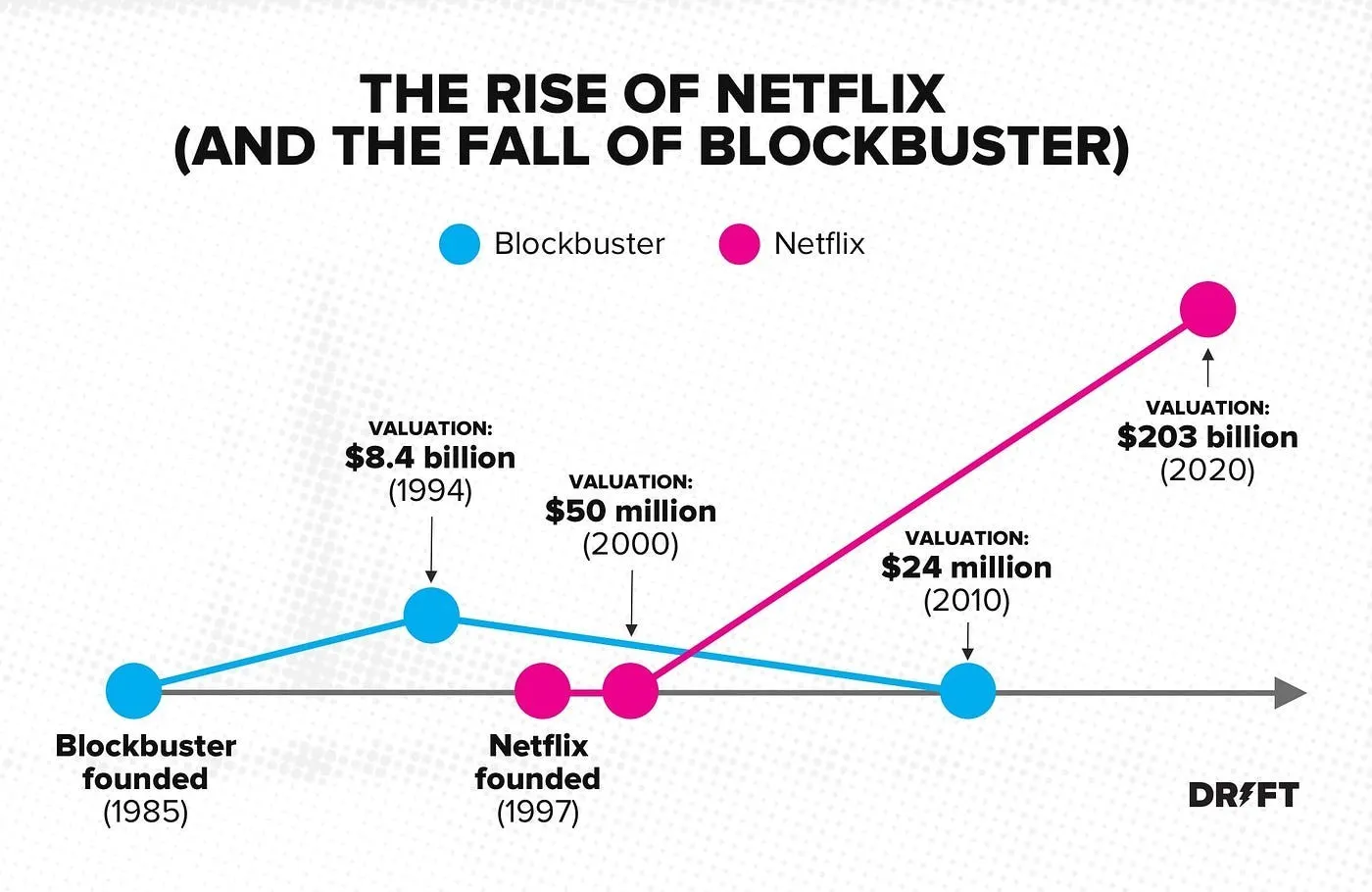
2005: "Netflix is just another way to rent movies"
(5 years later: Blockbuster filed for bankruptcy)
Your clients are saying the exact same thing about AI right now.
The difference is...you're letting them believe it.
The Transformation: What Your Clients Can't See (But You Must)
Here's the reality that's either gonna terrify you or energize you.
While 72% of organizations have already woven AI into their core operations, most are doing it completely wrong.
They're implementing AI without understanding their value chain.
They're chasing technology without measuring real impact.
They're optimizing processes that shouldn't exist at all.
And the most dangerous thing about this...
They're applying tomorrow's technology to yesterday's thinking.
This isn't just a challenge.
It's your opportunity to become the service provider, coach, consultant or advisor they can't succeed without.
By 2030, AI will inject $15.7 trillion into the global economy.
This isn't just growth.
It's a complete reimagining of how value is created and captured.
The Architecture: Your New Role as Value Chain Revolutionary
Irrespective of your "role" or whatever you call what you do...
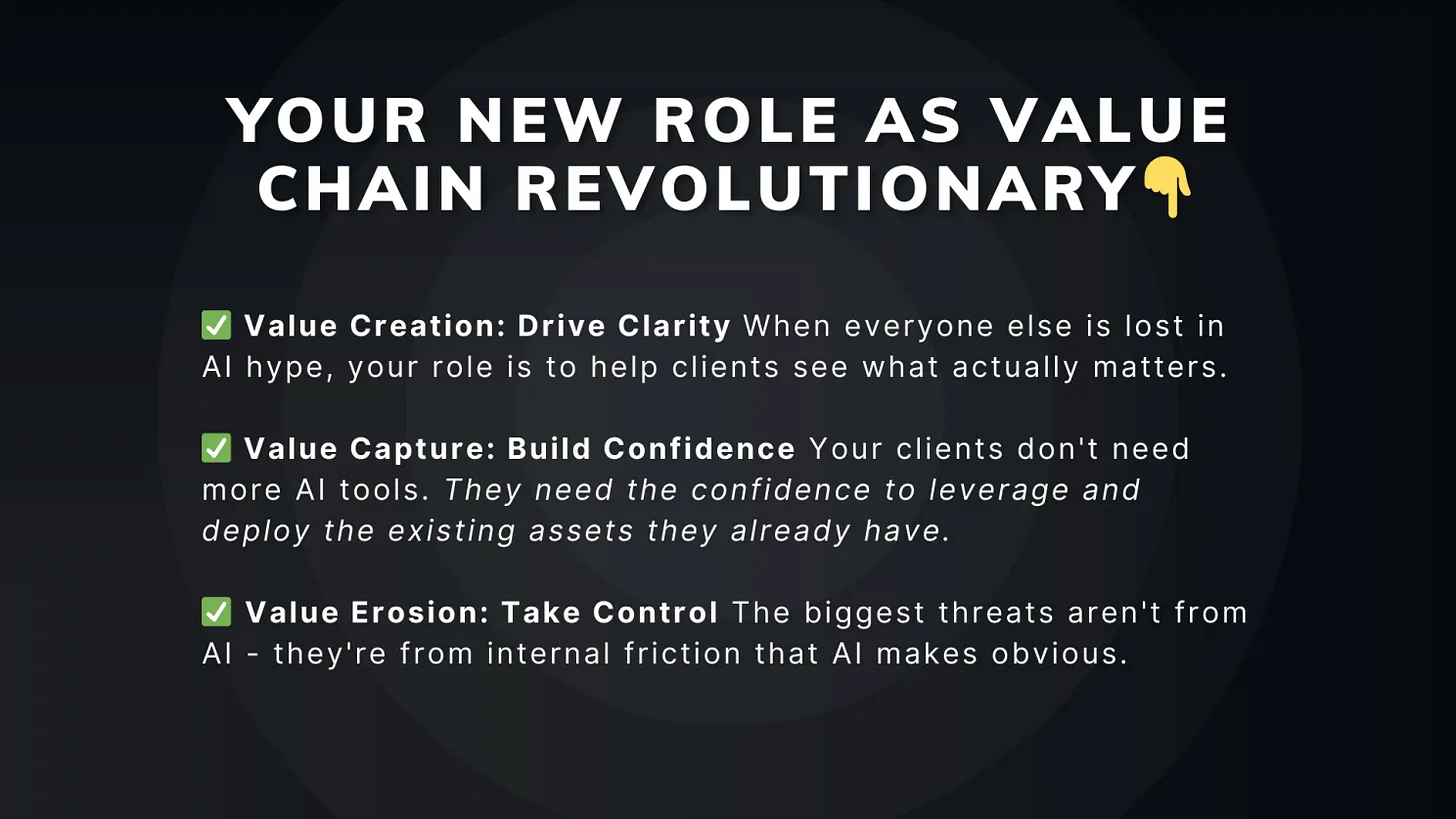
Our obligation is to guide our clients through three dimensions of transformation that separate survivors from casualties.
1. Value Creation: Drive Clarity
When everyone else is lost in AI hype, your role is to help clients see what actually matters.
Which small shifts will drive immediate revenue?
Where are the hidden performance gaps they can't afford to miss?
How can they spot opportunities before competitors do?
2. Value Capture: Build Confidence
Your clients don't need more AI tools. They need the confidence to leverage and deploy the existing assets they already have.
How can they leverage existing assets to create unfair advantages?
Where can they make faster, smarter decisions with data they already own?
Which systems need strengthening to thrive in any market condition?
3. Value Erosion: Take Control
The biggest threats aren't from AI, they're from internal friction that AI makes obvious.
Which processes are slowing down their sales opportunities?
How can they create seamless experiences that customers (and their teams) will love?
Where can they reduce risk while accelerating growth?
This isn't just about "asking questions".
Measure every initiative against these three critical currencies.
Cost: Real reduction in operational expenses
Time: Measurable acceleration of processes
Effort: Significant decrease in complexity
Need proof of what's possible?
It's projected that by the end of 2025, 95% of customer interactions will be AI-assisted.
But here's what should really wake your clients up...
When the Swedish fintech company Klarna's AI assistant handled 2.3 million customer conversations in its first month, work that would have required 700 humans, they weren't just reducing costs or saving time.
They were completely redefining what's possible.
That's not optimization.
That's transformation.
And to lead this transformation, we need to evolve ourselves first.
The Three Horizons: Your Transformation Roadmap
While others debate about whether AI will replace jobs...
Here are the three transformations you need to help guide your clients through.
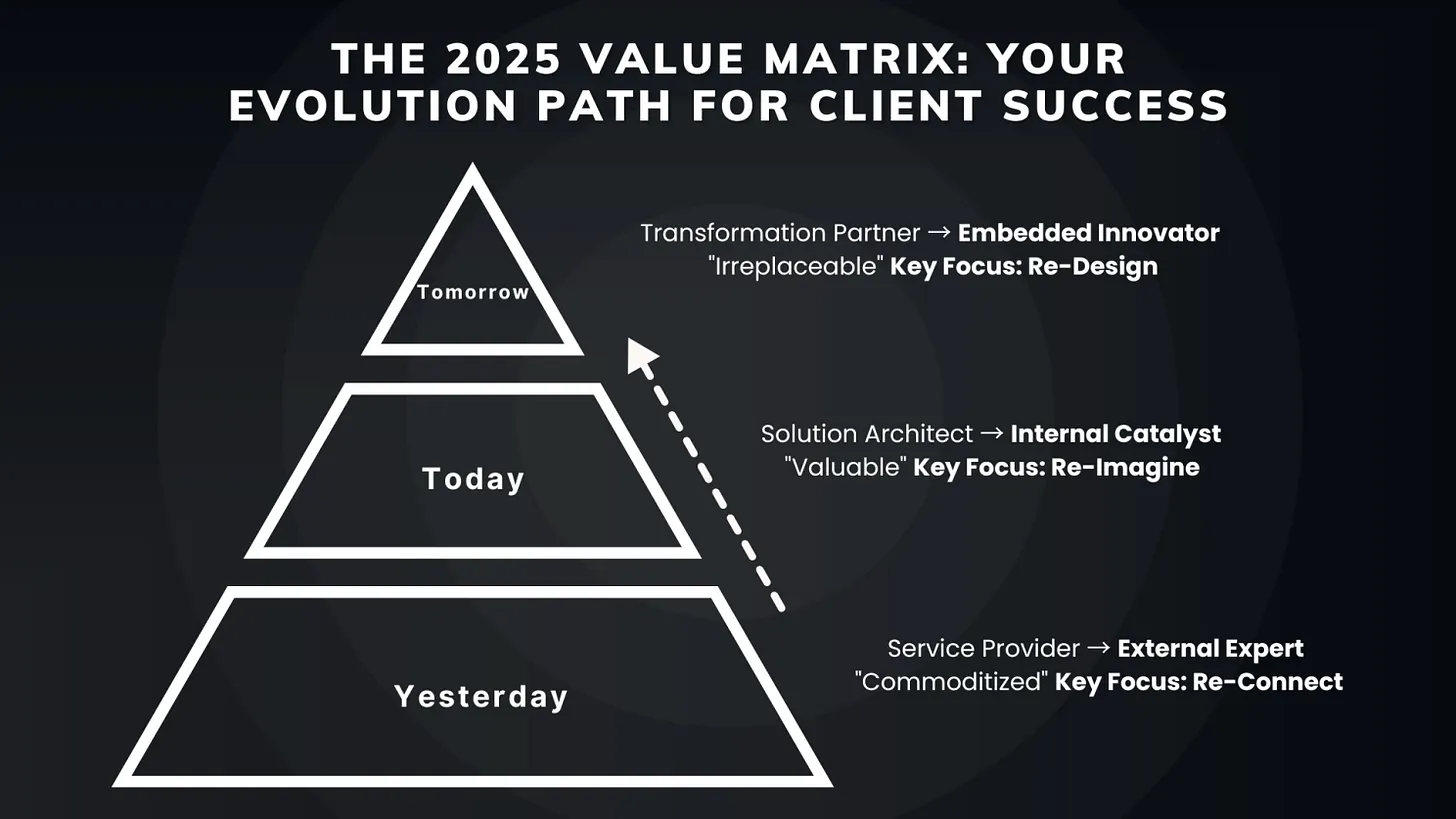
The 2025 Value Matrix: Your Evolution Path
So what does this look like out in the wild right now?
Yesterday: Service Provider, External Expert
The path to becoming commoditized (Fighting for relevance)
Today: Solution Architect, Internal Catalyst
The path to becoming valuable (Creating real impact)
Tomorrow: Transformation Partner, "Embedded Innovator"
The path to becoming irreplaceable (Driving transformation)
Your Evolution Journey
Re-Connect: Become part of your client's value creation DNA
Re-Imagine: Help clients see new possibilities
Re-Design: Shape your client's future success
Assuming you're in this for the long haul, what's more exciting than that!?
1. Generative AI Old world: "It creates content" New world: It unlocks $127B in creative potential Your role: Show them how to capture their share
2. Predictive AI Old world: "It forecasts trends" New world: It architects entirely new market opportunities Your role: Help them shape those markets
3. Automation AI Old world: "It replaces tasks" New world: It unleashes human potential Your role: Guide their evolution
The Shift: Your New Identity as Leader
Think of it this way.
Old World: You were a mechanic fixing broken parts
New World: You're an engineer redesigning how the machine evolves
Here's how to guide your clients through this fundamental shift.
Map value chains before suggesting solutions
Test against real problems, not impressive demos
Identify strategic drivers unique to their business
"Decouple" activities where traditional approaches create friction
The Moment of Truth: Your Call to Action
Remember the Blockbuster story?
Here's the part most people miss.
Blockbuster's advisors saw Netflix coming.
They wrote reports about it.
They monitored its growth.
They suggested "digital initiatives."
But they didn't flip the table.
They didn't sound the alarm.
They didn't force their client to face reality.
And now? They're part of the same cautionary tale.
The question isn't whether you'll adapt.
It's whether you'll lead your clients through the next chapter of business history or watch from the sidelines.
Your clients don't need another service provider telling them what they want to hear.
They need a trusted guide brave enough to tell them what they need to know.
That guide could be you.
But only if you choose to see and accept what others won't.
Only if you're willing to risk temporary discomfort for long-term trust.
Only if you're ready to stop being just another provider and start being the one who saw it coming.
Because in three to six months from now...
Your clients will either thank you for warning them...
Or blame you for staying silent.
Which conversation would you rather have?
Now listen.
If you're feeling the weight of this responsibility, and the opportunity it represents...
I want to share something practical with you.
I've developed a framework that helps business leaders transform their hidden business and marketing assets into predictable sales opportunities.
All while maintaining their freedom to lead transformation for their clients.
It's built around the three critical elements we discussed:
Clarity
Confidence
Control
And it's specifically designed for business leaders, coaches, consultants, and advisors who want to lead their clients through this AI revolution without getting swept away by it themselves.
Want to see exactly how this framework works?
Check the comments below for a clear path forward.
When I first shared this article, it struck a chord.
But with the Goldman Sachs data showing confusion at scale, and the AI bubble debate intensifying...its even more urgent now.
Your clients won't measure you by how many tools you recommend.
They'll measure you by whether you helped them see what mattered before it was obvious.
Because here's the reality: bubbles only burst for people who bet on the wrong things.
The leaders who win are the ones who refuse to let blind spots slide.
Stay sharp,
Colin Taylor
Creator of The Asset Alchemy Method
Frequently Asked Questions
What is the AI blindspot that costs service businesses clients and revenue?
The AI blindspot is the gap between AI adoption and strategic AI implementation. Goldman Sachs data shows 68% of small businesses use AI, but nearly half struggle to pick the right tools. Businesses are applying tomorrow's technology to yesterday's thinking, implementing AI without understanding their value chain, chasing tools without measuring impact, and optimizing processes that should not exist at all. The Asset Alchemy Method addresses this by building the foundation (Clarity, Confidence, Control) before layering AI on top.
Why will clients blame their advisors for missing the AI transformation?
Every major disruption follows the same pattern. Blockbuster's advisors saw Netflix coming, wrote reports about it, monitored its growth, and suggested digital initiatives. But they didn't force their client to face reality. Now they're part of the same cautionary tale. Your clients won't measure you by how many tools you recommend. They'll measure you by whether you helped them see what mattered before it was obvious.
What are the three dimensions of AI transformation that separate survivors from casualties?
Value Creation (Drive Clarity): helping clients see which small shifts drive immediate revenue and where hidden performance gaps exist. Value Capture (Build Confidence): helping clients leverage existing assets to create unfair advantages with data they already own. Value Erosion (Take Control): identifying internal friction that AI makes obvious, from slow sales processes to complexity that kills growth. Each initiative should be measured against three currencies: cost reduction, time acceleration, and effort decrease.
What is the evolution path from service provider to transformation partner?
Yesterday you were a Service Provider and External Expert, fighting for relevance on the path to being commoditized. Today the opportunity is to become a Solution Architect and Internal Catalyst, creating real impact. Tomorrow the goal is Transformation Partner and Embedded Innovator, driving transformation and becoming irreplaceable. The Asset Alchemy Method builds this evolution through systematic extraction of institutional knowledge and strategic positioning.