August 2025.
I was listening to Mo Gawdat on Diary of a CEO, and one line stopped me.
Not the doom and gloom ones a lot of people were clipping.
A quieter one.
About what happens to expertise when everyone can borrow the same intelligence.
I built an issue around it.
You'll read the relevant part in a minute.
We're one year in.
And the machines got there early.
Six weeks after I published, a benchmark went up that tests AI against real professional deliverables.
- legal briefs
- financial models
- the kind of work you'd hand a client
Graded blind against the experts who normally produce it.
A year ago the AI lost most of those matchups. Now it wins or ties about three out of four. That's ahead of schedule.
And almost nothing happened.
Not nothing exactly.
You've seen the announcements.
Agencies trimming, teams consolidating, roles quietly absorbed and never refilled.
Some of it may have landed on people you know.
Ironically, a few of those companies went looking for the same people a year later.
But when Erik Brynjolfsson's team at Stanford went through payroll records for millions of workers this summer, the aggregate barely moved.
No broad displacement.
No collapse in what anyone gets paid.
I'm not saying the cuts aren't real, because they are.
They're just not the only thing that's actually happening.
I've been sitting with that gap for a few days.
It's the most important thing in this entire story, and it's not what I expected to be writing about this week.
Here's the part of the original that matters now. Then meet me at the end.
Picture this.
It is 2027.
You and your sharpest competitor both have access to AI with the same 4,000 IQ points.
The MBA, the certifications, the expertise you have spent decades building?
Statistically meaningless.
But your 15-year client relationship...
The one who calls you before making any major decision because they trust how you see the situation?
Priceless.
Some people hear this and rush to one extreme.
"AI will do everything, humans will not matter."
Others plant their flag in the opposite camp.
"Nothing should be done with AI, it is dangerous."
Both extremes miss the real play.
The advantage is not in the AI-or-no-AI shouting match.
It is in the middle path...
Where the smartest leaders are quietly building an edge no algorithm can erase.
Using AI for what it does best, while doubling down on the human trust, judgment, and perspective it cannot replicate.
That is exactly where the Clarity, Confidence, Control framework in The Asset Alchemy Method keeps you anchored as the market polarizes.
Mo's Hidden Signal in the Noise
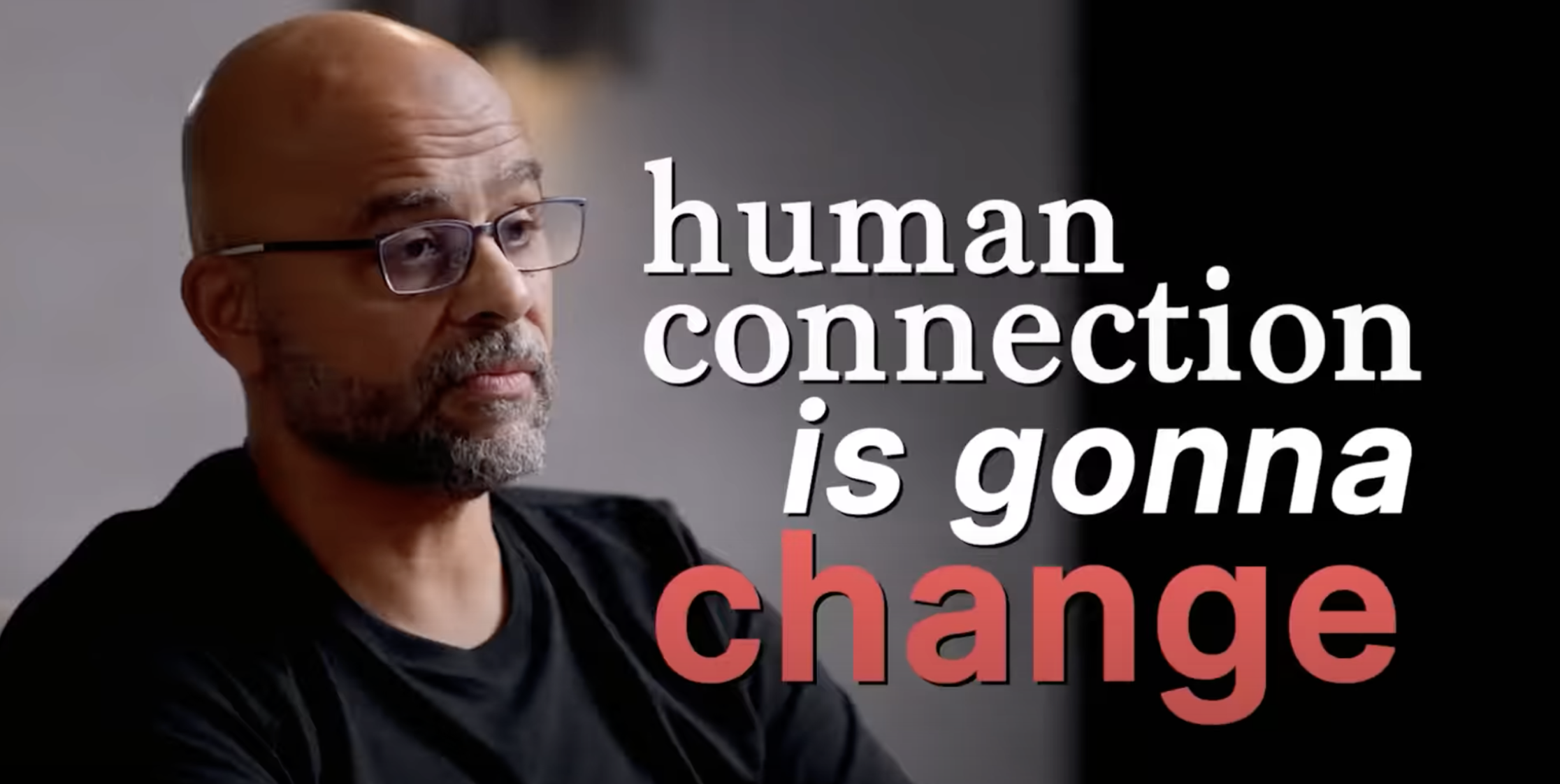
As you listen to Mo Gawdat speak about AI on Steven Bartlett's podcast, most people lock onto the shock value of his predictions.
But buried inside the interview was a quieter signal.
One that points directly to the most important competitive shift of the next three years.
When everyone has superintelligence, competitive advantage shifts entirely to what cannot be augmented.
Mo put it simply.
"Whether you are smarter than me by 20 or 50 points made a difference before. But in the future, if we can all augment with 4,000, it really does not."
Translation: your intellectual edge disappears.
Your relationship assets, and the perspective you bring to them, become everything.
Not just any relationships.
The ones where you are the guide through chaos. The person they call to:
- Cut through the noise when every option looks the same
- Help them decide when they are overwhelmed
- Keep them moving when everything else feels unstable
Here is the part most people overlook.
A lot of your relationship capital is trapped value.
Sitting in plain sight. Producing nothing.
And the closer we get to cognitive equality, the more dangerous that waste becomes.
That's the section that matters for what follows. Read the full issue here →
One Year In...Here's What The Gap Actually Means
A year ago I called that trapped value.
It's worse than that now.
You've probably noticed the same thing I have.
You were told everything was about to change.
Then twelve months passed, and your business looks roughly the same.
- Clients still call
- Revenue held
- Nobody handed your work to a machine
(You might be reading this thinking exactly that.)
It's tempting to file that under overblown.
Don't.
The capability is real, and it arrived faster than I wrote.
What hasn't arrived is the consequence. Those are two different clocks, and a lot of people are watching the second one and concluding the first one was noise.
There's one place the ground already moved, and it isn't where everyone's looking.
Plenty of people lost jobs this year, and plenty of those announcements named AI directly.
I'd take those at face value if I hadn't spent the last two years watching companies discover that "we're becoming AI-first" reads better to investors than "we over-hired in 2022."
Some of them quietly started rebuilding the teams they'd initially cut.
A layoff announcement isn't a measurement. It's a communications decision.
Here's what convinced me.
The researchers publish the reasons they might be wrong.
- Education explains part of the gap.
- Some of the trend shows up before ChatGPT.
- Their sample runs hotter than the national numbers.
The people holding the data list their doubts. The people holding the press release never do.
Payroll records are a measurement.
And in the occupations most exposed to AI, they show separations going down.
What they show instead is two numbers moving in opposite directions.
Since late 2022, employment for 22 to 25 year olds in the most exposed jobs fell about 11%.
Same age group, least exposed jobs, grew about 10%.
That gap isn't people leaving. It's people never arriving.
Nobody issued a press release.
Nobody walked it back.
The door just closed, quietly, and it stayed closed.
That's the thing.
The loud number is negotiable...it gets announced, spun, and sometimes reversed.
The quiet one is the one repricing your market.
And it went after the most copyable work first.
The junior tier. The tasks that live in a manual.
The copyable half of your expertise is already being repriced, and the relational half is being amplified for anyone who's been at this twenty years.
The market hasn't finished sorting you yet.
That's the gap. Not a reprieve. A window.
When I wrote picture this, it is 2027, it was a thought experiment two years out.
It's next year.
So here's the only question worth asking inside this window.
Does the thing that makes you irreplaceable exist anywhere outside your own head?
The judgment. The relationships.
The way you see a client's situation before they can explain it.
Because if it doesn't, it can't be scaled.
Can't be sold.
Can't be delegated or defended.
It can only be spent.
The window is the only part of this with a deadline.
Twenty-four months, give or take.
Then the market finishes sorting you.
Stay surgical,
Colin Taylor
Creator of The Asset Alchemy Method
P.S. The paper is "Canaries in the Coal Mine?" by Erik Brynjolfsson, Bharat Chandar, and Ruyu Chen at the Stanford Digital Economy Lab. They also run a dashboard now that updates the numbers monthly, which is more useful than the paper. The part worth two minutes is the list of jobs carrying the least exposure. Therapists. Social workers. Sales managers. Lawyers. Not the jobs that need presence. The jobs that need trust.
Sources
Erik Brynjolfsson, Bharat Chandar, and Ruyu Chen, "Canaries in the Coal Mine? Six Facts about the Recent Employment Effects of Artificial Intelligence," Stanford Digital Economy Lab https://digitaleconomy.stanford.edu/publication/canaries-in-the-coal-mine-six-facts-about-the-recent-employment-effects-of-artificial-intelligence/
Stanford Digital Economy Lab, "Canaries Dashboard" https://digitaleconomy.stanford.edu/project/indicators/canaries-dashboard/
Stanford Digital Economy Lab, "No Widespread Displacement, but the AI Employment Gap for Young Workers Has Widened to 19%" https://digitaleconomy.stanford.edu/news/canariesaug26/
Frequently Asked Questions
What does the Stanford Canaries in the Coal Mine study say about AI and jobs?
The study by Erik Brynjolfsson, Bharat Chandar, and Ruyu Chen at the Stanford Digital Economy Lab examined payroll records for millions of workers and found no broad displacement and no collapse in pay. What it found instead was a gap by age and exposure: since late 2022, employment for 22 to 25 year olds in the most AI-exposed occupations fell about 11%, while the same age group in the least exposed occupations grew about 10%. In the most exposed occupations, separations went down. The change is in hiring, not firing.
Why haven't AI layoffs shown up in the data yet?
Capability and consequence run on two different clocks. AI capability on professional deliverables advanced faster than most 2025 predictions, but a layoff announcement is a communications decision, not a measurement. Companies have strong incentives to attribute cuts to becoming AI-first rather than to over-hiring, and some have quietly rebuilt teams they cut. Payroll records are the measurement, and they show the repricing happening at the entry tier through hiring that never occurs rather than through visible displacement.
Which parts of professional expertise are most exposed to AI?
The copyable half. Any task that lives in a manual, follows a documented procedure, or can be specified clearly enough to hand to a junior is the part being repriced first. The relational half, meaning judgment, trust, and the ability to read a client's situation before they can explain it, is being amplified for experienced operators. In the Stanford data the least exposed occupations were therapists, social workers, sales managers, and lawyers, which are the jobs that require trust rather than the jobs that require presence.
How do I document expertise that only exists in my head?
Start with the four categories in the K.A.S.H. Framework: Knowledge, Attitude, Skills, and Habits. Knowledge is what you know about clients, markets, and patterns. Attitude is the judgment calls and thresholds you apply without noticing. Skills are the repeatable procedures. Habits are the sequences you run automatically. Extraction means capturing the decisions and the reasoning behind them, not just the steps, because the reasoning is what makes the output defensible. Undocumented expertise cannot be scaled, sold, delegated, or defended. It can only be spent.
Why does undocumented expertise lower the value of a service business?
A buyer is purchasing what transfers. Judgment that lives only in the founder's head does not transfer, which is why founder-dependent firms are valued as expensive jobs rather than as compounding assets. Documenting the method, the decision logic, and the relationship history converts personal expertise into business property. It also creates the foundation AI tools need in order to produce anything worth using, which is why extraction comes before implementation in the Asset Alchemy Method.