Three empires wanted him.
Britain, France, and Spain. All of them pressing on the same ground, in the early 1700s.
Each with soldiers. Each with forts going up on his borders.
Each certain he'd have to choose one and become its instrument against the other two.
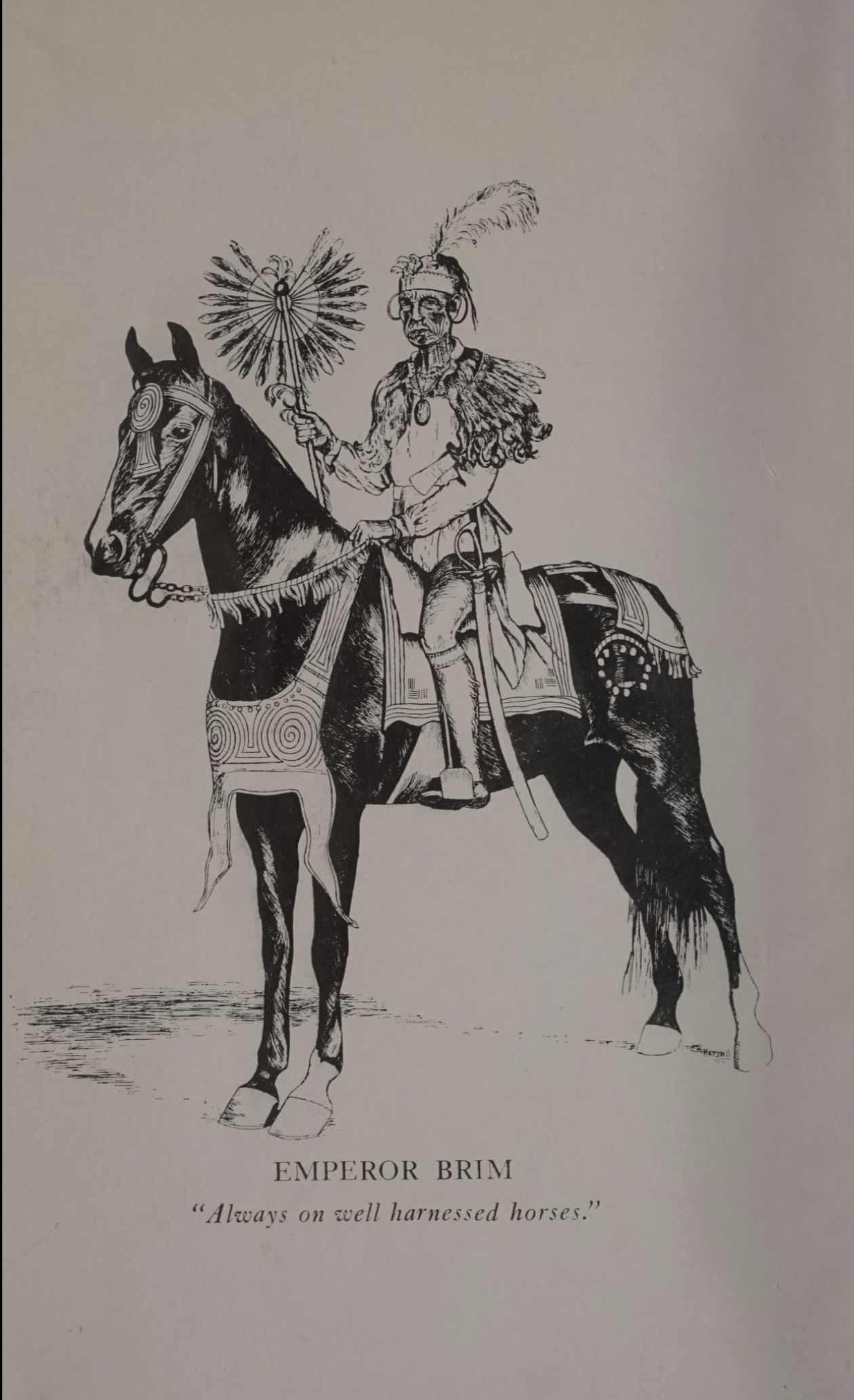
The man they were courting was Emperor Brim. A Muscogee mico, a chief of the Lower Creek town of Coweta.
One town, a Creek capital, on the Chattahoochee, right where Columbus, Georgia meets the Alabama line today.
He couldn't out-fight any of them. Not one, let alone three.
So in 1718 he did something harder than fighting.
He invited representatives of all three to his village. And in council with Upper and Lower Creek leaders, he declared the Creeks neutral.
Not weak. Not hiding. Neutral on his own terms.
He kept trading with all three. He just refused to belong to any of them.
I want you to hold that image. Because it's yours now.
You Are Already Surrounded
You don't have three empires to contend with. You have more.
- The platform that hosts your audience.
- The models you build your work on.
- The market that reprices your value every quarter.
None of them you own.
And all of them want you dependent.
Each one is happy to host you, tool you, distribute you.
Right up until the morning it decides not to.
You can't out-fight them either.
You're not going to beat the platform, out-scale the model, or slow the market down.
So the question Brim answered in 1718 is the exact question on your desk today.
How do you stay free when you're surrounded by powers you can't defeat?
The Peace Brim Never Got
There's an idea I've carried for years without ever reading the book it came from.
A colleague described it once. It stuck.
In his book The Hard Thing About Hard Things: Building a Business When There Are No Easy Answers, Ben Horowitz drew a line between two kinds of leader.
Peacetime and wartime.
Peacetime is when you hold a real advantage in a growing market. You expand. You widen the lead.
Wartime is when something can kill you. The rules invert. You fight for every inch.
It's a good frame. It held up for over a decade.
But it assumes something Brim never had, and neither do you anymore.
It assumes the seasons take turns.
That you get stretches of peace to build, and stretches of war to survive, and you'll always be able to tell which one you're in.
Brim was never in one season.
He was surrounded and building at the same time. For decades.
Permanently at war, because three empires wanted him gone.
Permanently at peace, because he never stopped trading, growing, holding his ground.
He didn't get to pick a mode. He ran both at once, or he lost everything.
No Ceasefire, No Off-Season
Horowitz wrote in 2014. Twelve years ago.
Before a lab could hand your whole competitive set the same capability you spent a decade earning.
Before the platform you built on could evict you by algorithm.
Before "a durable advantage" had a shelf life measured in quarters.
The frame wasn't wrong. The world underneath it changed.
Peacetime stopped arriving.
You're in Brim's condition now. Both seasons, same morning.
Defending an advantage that's eroding under you.
And building the next one. Same quarter, same tired team.
You don't get the calm season to coast in.
You don't get to rest and rebuild.
You get both, at once, from here on.
Which is exactly the situation Brim survived for decades.
So the useful question isn't how he won. He didn't win. He never beat anyone.
The question is how he lasted.
Holding Was the Whole Game
Not everyone admired him.
Some saw a shrewd strategist who kept his people free.
Others saw a man who wouldn't commit. Who kept shifting. Who played all sides.
Crafty fluctuations, his critics called it.
But look at who those critics were.
The ones who committed, who pledged themselves to one empire to look principled, were the ones who got absorbed.
Brim's refusal to belong wasn't weakness. It was the whole reason he stayed free.
He lasted because he understood one thing his rivals didn't.
His position wasn't a possession. It was a practice.
Neutrality that isn't tended collapses. The moment he stopped working the rivalries, stopped maintaining the balance, whoever moved fastest would own him.
So he never stopped. The independence held because he held it, every day, on purpose.
Here's Why This Matters for You Today
Most advice stops at "own your assets." As if owning were the finish line.
It isn't. It's a practice, the same as Brim's neutrality.
There was a time you could neglect an asset and it would hold.
The market moved slowly enough to protect it for you. That time is over.
So neglect isn't neutral anymore. Neglect is erosion.
Your best assets get overlooked. Undervalued. Miscalculated.
- The client list nobody's touched in a year.
- The proposals you already wrote.
- The recorded calls where you explained, better than you have since, exactly how you solve what you solve.
Sitting in folders. Worth less every month you don't touch them.
Not gone. Not stolen. Just eroding, in a market moving faster than the folder.
The asset didn't leave. Your attention did.
Brim's position didn't hold because he set it once. It held because he maintained it.
Same as everything you own.
What He Refused to Trade
Here's the part of Brim's strategy that's easy to get wrong.
He didn't withdraw.
He didn't go independent of the three empires. He couldn't, and he didn't try.
He traded with all of them. The trade was the whole point.
What he refused to trade away was the independence underneath the trading.
That's the move. Not isolation. Engagement without capture.
You'll use the platforms. You'll use the models. You have to, and you should.
Almost nobody gets to stand fully apart from these powers.
If you could own the whole field, owe nothing to anyone, you would. That's the strongest position there is.
But you probably can't. So you do what Brim did.
You trade with every empire. You just refuse to belong to one.
Your judgment. Your proof. Your relationships.
The specific way you solve a client's problem that no model can reverse-engineer from the outside.
You pour all of it through platforms you'll never own.
But because the substance is yours, no single platform's bad morning can erase you.
Only your own neglect can.
Plenty of others traded with those same empires and slowly became their instruments. Brim traded and stayed himself. That's the whole difference.
This Was Never About Defense
There's a reason Brim did it. And it wasn't to hoard power.
He held it so his people could keep their land, their trade, their way of living.
So they'd never feel the empires pressing, because he absorbed the pressure for them.
The strength wasn't for him. It was so his stewardship couldn't be interrupted by forces outside his control.
That's the whole point of making yourself unassailable.
Not to hide. Not to hoard.
So that when the platform bans you, or the market floods, or the tool changes overnight, the people who depend on you never feel it.
That's the thing a subscription-only competitor can never do.
Not because they lack the tool. Because they've built nothing worth protecting, and they're holding no one but themselves.
Peacetime isn't coming back. You're in Brim's seat now, and the seat comes with his job.
Name what you own. Find what's eroding. Tend it before it's gone.
Sit at the table with all three empires. Trade with everyone.
And never let sitting there cost you the one thing that was ever really yours.
P.S. Naming what you own and catching what's eroding before it's gone is the whole reason the Asset X-Ray exists. It's a structured look at what your business actually owns versus what it's renting, and where the value is quietly leaking. If that's a look you've never taken, it's usually the most uncomfortable and most valuable hour on your calendar.
Sources
Peacetime and wartime leadership frame: Ben Horowitz, The Hard Thing About Hard Things (2014). Concept origin: "Peacetime CEO/Wartime CEO," a16z, https://a16z.com/peacetime-ceo-wartime-ceo/
Emperor Brim and the Coweta Resolution (1718): Melissa A. Stock, "Emperor Brim," Encyclopedia of Alabama, https://encyclopediaofalabama.org/article/emperor-brim/
Brim's contemporaries' mixed views ("crafty fluctuations"), his Yamasee War role, and Coweta leadership: Julie Anne Sweet, "Brims," New Georgia Encyclopedia, https://www.georgiaencyclopedia.org/articles/history-archaeology/brims-d-1733/
Frequently Asked Questions
What does it mean to say owning a business asset is a practice, not a finish line?
It means owning an asset once does not keep it valuable. Client lists, documented processes, proposals, and recorded expertise all lose value when they are ignored. In a slow market, neglect was safe. In a fast-moving market shaped by AI, neglect is erosion. The asset only holds its value if it is actively maintained, reviewed, and used.
What happens to a business when institutional knowledge is not documented?
When the knowledge of how a business works lives only in the owner's head, it cannot be transferred, defended, or scaled. It quietly loses value, weakens the business against competitors and market shifts, and lowers the business's worth in any future sale. Documenting institutional knowledge turns an owner-dependent job into a transferable, compounding asset.
How do you stay competitive when everyone has access to the same AI tools?
A subscription buys competence, and competence is no longer a differentiator once it is available to your whole market. What cannot be copied is the substance you own: your judgment, your proof, your relationships, and the specific way you solve a client's problem. You use the platforms and models fully, but the defensible value is what those platforms cannot take from you.
What is the AI-era update to the peacetime and wartime CEO framework?
The peacetime and wartime CEO framework assumes the two modes take turns, with stretches of calm to build and stretches of crisis to survive. In the AI era, that separation collapsed. Advantages erode in quarters, platforms can remove you overnight, and you must defend and build at the same time. The update is that leadership now means running both modes at once and continuously tending what you own.