Okay, so imagine two messages.
Same sender, same ask, sent the same week.
And you probably called it before you finished reading either one.
Ten seconds, if that.
Everybody picks the same one. That part's not interesting.
What's interesting is the question most people don't stop to ask.
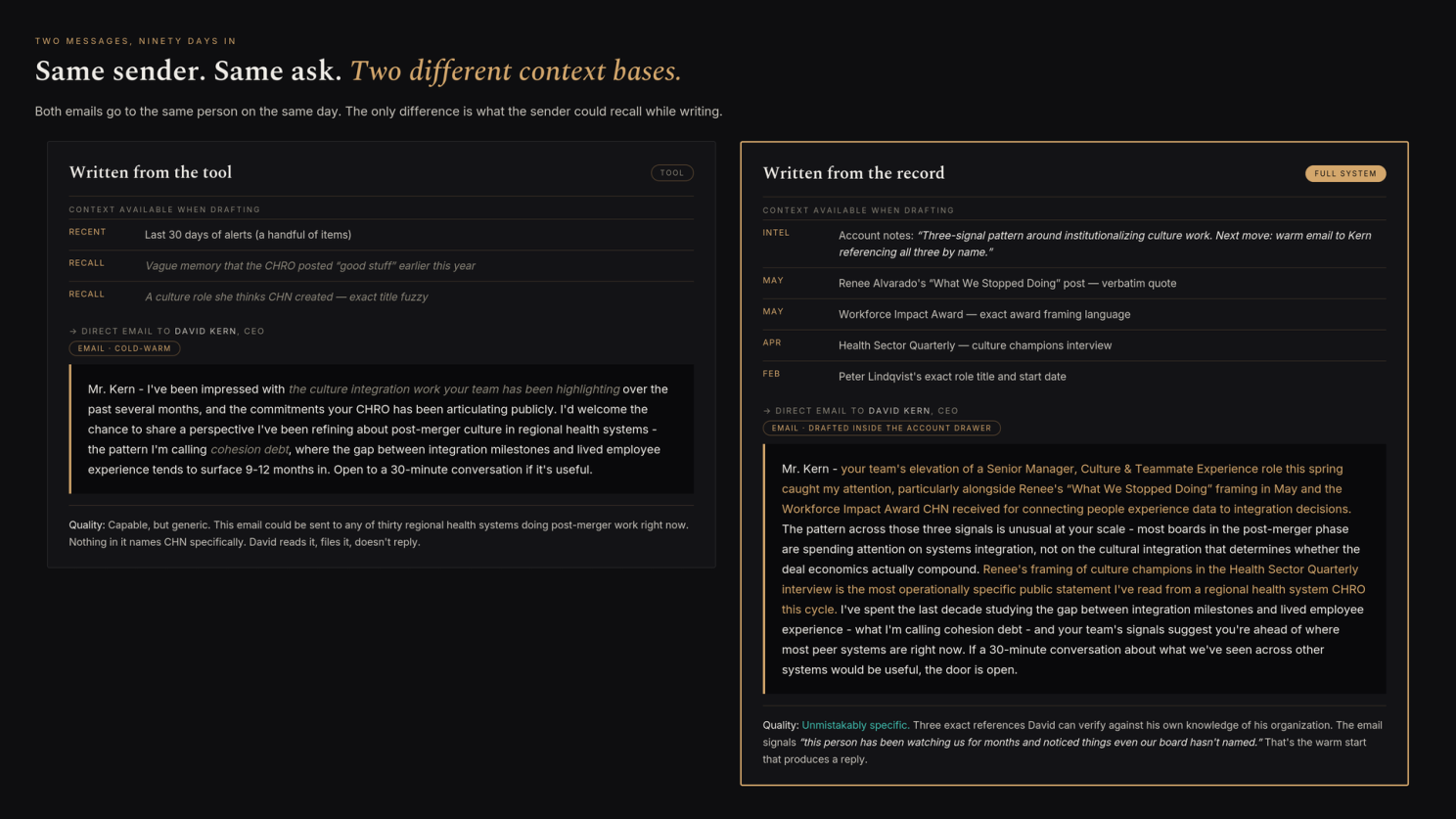
What would you actually have to know about a human being to write the one on the right?
I'm not talking about their title, or their headcount, or anything else that was relatively true a year ago.
None of the stuff a tool hands you on a plate.
I mean the thing they said back in May that nobody bothered to respond to, and why it mattered so much to them at that particular moment.
Or the topic they've quietly started posting about three times as often as they used to, without ever once saying what they actually need.
That last one is the whole game, by the way.
And this is what bothers me.
Nothing is stopping YOU from writing that message.
It isn't a time problem.
You'd give an hour to somebody worth an hour, and so would I.
It's that the hour doesn't help.
What you're missing is the six months of noticing that sits underneath it.
Last week I said there was a version of this for people who've never heard your name, and that it wasn't what you were picturing.
So. The cold version.
Where the person has no reason to care.
And would delete your email without opening it if it showed up looking like everything else in there.
When somebody already knows you, the history is just sitting there waiting on you.
And the work is going and digging it up.
With a stranger? Nothing.
Nothing to dig up, nothing to reference, no shared anything.
Which means you're not looking for the memory. You're starting one.
Months before you ever say a word to them.
The Gray Area
You're probably picturing AI SDRs and intent data.
Personalization tokens that drop in a company name, and call it homework.
None of that is "wrong", and some of it works fine for what it's for.
It's just that everybody already has it.
And your prospects pick up on it in about two seconds.
The trap is that most of us think we've only got the two options.
1. Hand it to a mass-market outreach shop.
Who will run volume...put your name on something you'd never write in a hundred years, and generate replies from exactly the people who were never worth reaching.
2. Do it yourself, in Sales Navigator.
Which is a genuinely good tool that wasn't built to go where you're trying to go.
So you sit in the gray area between spray, and manual, running neither one properly.
Sending fewer messages than the volume crowd, and worse ones than you're capable of, and telling yourself you'll get to it properly next quarter.
I wrote about why in May. Your stack filters. It doesn't remember.
Sales Nav alerts expire.
Apollo's expire.
Clay will tell you an event happened and have no idea what it means.
Sitting next to the other eleven things you noticed over the last six months.
Same two forces I've been tracking all year, by the way.
Synthetic content is why real attention got scarce.
And buyer bottlenecks are why access alone stopped being enough.
Which together is how the middle became the only place left worth standing.
And the middle is exactly what nobody sells.
The Thing You Needed Wasn't For Sale
In May I told you this needed infrastructure, and then I never showed you any.
Here's why.
When I said the answer wasn't more tools, what I actually meant was that the thing you needed didn't exist to be bought.
Nobody builds it. There isn't even a category for it.
For a long time, that's where the conversation ended.
It isn't anymore.
So I built the thing. For me. An internal app. Not a product.
Built because by hand, at the depth I actually want, I top out at a handful of accounts.
And I wanted that depth on all of them.
It's the right question and I'll come back to it, though probably not where you expect.
And notice what this isn't.
It isn't the guy posting every ten seconds about a release that changes nothing about how your business runs on Monday.
And it isn't the automation vendor selling you a workflow you were never going to buy.
One instrument, built for one problem, used by the person who built it.
And nobody can reprice it, throttle it, or decide on a Tuesday that it looks like slop.
Look At The Dates
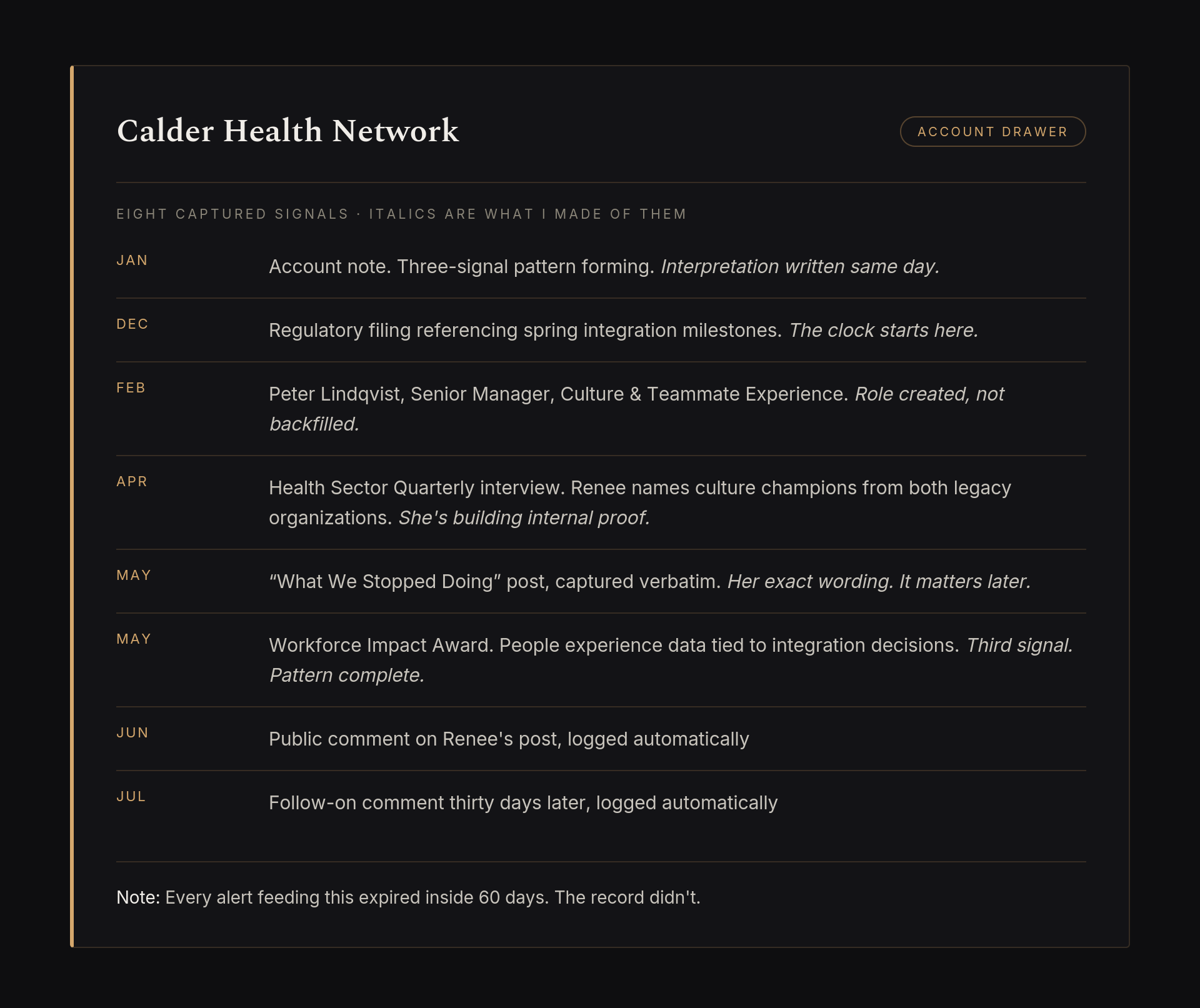
Names changed. Everything else is exactly what it looks like.
Not this week's alerts. Not a feed.
It's a running record of what I noticed about one organization over months, sitting right there next to what I made of it at the time.
A role created in February that nobody backfilled, which is a different animal from a role being filled.
A post in May about what they'd stopped doing, captured verbatim because the wording mattered.
An award that spring for something most companies in that position don't measure, let alone win anything for.
Take any one of those on its own and you'd feel ridiculous writing a message about it.
You'd be the guy emailing a stranger about a press release.
Put all eight together and you're not looking at a company anymore.
You're looking at what somebody decided to care about while nobody was watching.
That's the gap between knowing a name and knowing a story arc.
And you already have some version of this.
It's in your head, in a Slack DM to yourself, in the margin of a notebook.
It just doesn't survive the week.
It's Holding My Discretion
This is the part that took me embarrassingly long to see.
It isn't holding my notes.
It's holding my discretion.
What counts as a signal, what I ignore, and why.
Which change in somebody's world means something and which one is noise.
When a thing is worth writing down and when it absolutely isn't.
Go back to that February line for a second. A role created, not backfilled.
Nothing in the world tells you that matters. No alert fires on it.
It's a call I make in about a second and a half, built on a decade of watching what happens to people after their companies merge.
And if I don't write down why it caught me it's gone by Friday and February is just a name and a job title.
None of that is "information". That's how I decide.
And the second it's written down, it stops being just a habit. It becomes an asset.
Which is funny.
I've spent years pulling exactly this out of other people's heads.
The methodology they can't quite explain, the judgment call they make so fast they don't even register making it. It's most of what I do for a living.
The difference is that there was never anywhere to put it. You could document somebody's judgment all day.
Making it operational meant an enterprise budget and a dev team.
That's the part that changed.
So this year I pointed the same extraction at business development.
How you decide who's worth the attention, and when.
Mine first. My clients' next.
So the machine collects and surfaces. That's its whole job.
I'm the one who decides what any of it means.
Back in May I sketched out a hybrid where AI handles most of the capture and the human adds judgment on top.
And I told you straight that I hadn't seen enough operators run it to know whether the thing held up under real conditions.
I still can't tell you that.
What I can tell you is that I spent the months since building the logic out properly, and it goes live with a client this month.
So I'm not writing this from the far side of a result.
I'm writing it from the part where you've already committed, and the returns aren't in yet.
And it works precisely because it isn't generic.
Every tool you can buy asks you to accept somebody else's opinion about what matters.
This one runs on mine.
Yours would run on yours, which is the whole point.
And it's also why nobody can hand it to you finished.
The Second Opinion
Reactivation worked because the trust already existed. You earned it years ago and went and found it again.
This works because the trust arrives already built.
Think about what that email actually does. It doesn't ask for anything.
It tells a CEO what three signals in his own organization add up to, in language he can check against what he already knows.
By the time somebody in that position replies, the diagnosis has already happened.
He isn't evaluating whether I know his sector. He's asking what I'd do about it.
That's prescription positioning, and it's the difference between a sales conversation and a second opinion.
A sales conversation, you're proving you deserve the meeting.
A second opinion, they walked in already believing you see something, because you named the thing they'd been half-suspecting about themselves.
That's Conversion.
Traffic is the last corner, and it's a different problem entirely.
Now The Part Nobody Wants
It's slow.
First ninety days, it produces very little you can point at.
The documentation is still manual. I write the notes myself.
All the surface does is make sure they don't evaporate by Thursday.
I get it.
In a market that pays for speed, that's a rough sell, and I'm not going to pretend the math looks good in month two.
So let me tell you about the first time I did this. By hand, before any of it had a name.
2008.
Like a lot of people, my wife lost her job.
I was working at Apple at the time and thought there might be something for her there.
She wasn't so sure. So I didn't push.
I went to LinkedIn instead and found the recruiters, the managers, the regional directors in our area.
And I didn't pitch her to any of them.
I mentioned things I'd noticed, and asked them some questions.
If you knew somebody who'd be really good for a role like this, how would you go about it? What would you tell them?
Planting the question instead of the ask.
I even asked my own regional manager in person, and he brushed me off.
I remember thinking: okay, but you don't know what I know about my wife.
I don't remember exactly what I wrote in those messages.
I remember what happened.
She applied.
And I knew her name would have to cross at least a few of the desks I'd been quietly talking to.
A while later, that same manager brought her up on his own.
"Hey, you know what's interesting? I've heard about your wife from a couple of people."
That was me doing this by hand.
One account, for one person I loved, and it took months, and the whole thing lived in my head and nowhere else.
The surface is that, without the forgetting.
And not for one account at a time. For twenty plus at once.
Everybody wants the surface. Nobody wants the notebook.
Quick Test
Now, that thing I told you to hold onto.
A year ago I drew you a diagram about outside vendors working their way in until they're hard to replace.
This is just me doing what it says.
The only reason this thing exists is that I got to work inside a client's business instead of pitching at it from across a table.
Close enough to the actual problem to spot something worth solving that nobody happens to be selling.
Anybody standing where I was standing would have seen it.
That's the point.
So the question was never whether you could build one.
It's this.
Who in your business is standing close enough to see something like this?
I don't mean do you have an "AI person".
I mean is there anybody you employ who's positioned to notice a problem that doesn't have a product attached to it yet.
And who'd have the room to do something about it if they did.
If nobody is, it isn't that you're turning these down.
You just can't see them.
One Move This Week
Don't build anything.
Pick one account you'd genuinely love to be working with a year from now.
Start a file. Today.
By hand, in whatever you already have open.
Write down one thing you noticed about them this week, and why it caught you.
Then do it again next week.
Six months from now you'll be holding something nobody can sell you, and you'll know exactly what the surface is for.
You already noticed something about somebody this week.
By Thursday, you won't be able to name it.
Stay surgical,
Colin
P.S. That seat gets filled one of three ways. It's you, it's somebody already on your team who nobody's given the room, or it's somebody from outside holding the position while it gets built. If you're not sure which one you're looking at, that's usually a twenty-minute conversation. Door's open.
Frequently Asked Questions
Why does cold outreach fail even with personalization tools?
Because the tools filter instead of remember. Sales Navigator alerts, Apollo links, and Clay signals all expire within weeks, so every message gets written from this week's context instead of months of accumulated noticing. Prospects recognize token personalization in about two seconds. What earns a reply from a stranger is evidence that somebody has been paying attention over time, and no tool on the market holds that.
What is prescription positioning?
Prescription positioning is when a prospect arrives already believing you see something about their situation, because your outreach named a pattern they had been half-suspecting about themselves. It turns a sales conversation into a second opinion: instead of proving you deserve the meeting, you are confirming a diagnosis they can check against what they already know. It is the Conversion point of the Asset Alchemy Profit Compass.
How do you build a relationship with a prospect who has never heard of you?
You start the memory instead of looking for one. Track a small number of target accounts over months, write down what you notice and why it caught you, and let the record accumulate. When the pattern completes, your first message can reference specific, verifiable signals from their own world. The 2008 version of this was done by hand on LinkedIn with one account. The principle scales to twenty-plus accounts when the noticing is captured instead of forgotten.
What should AI handle in business development, and what should stay human?
The machine collects and surfaces. The human decides what any of it means. AI can capture signals, hold them next to your notes, and keep months of context from evaporating. The judgment layer, what counts as a signal, what to ignore, and when to move, has to come from documented human discretion. That is why a generic tool cannot do this: every tool you can buy runs on somebody else's opinion about what matters.