If you've been using AI long enough...
You already know the moment I'm talking about.
You're six prompts in.
The output almost works. You know it's not quite right.
But you've been at it for a while.
Now you've got a meeting to prep for, and you don't have another round of correction in you.
So you tell yourself it's good enough and you move on.
I get it. And I'm not picking on you.
And that's not a moment of personal failing.
It's actually a measured phenomenon.
But I want you to think about something because this is important.
Imagine that same moment.
Happening in every workflow across your clients' teams this quarter.
At scale. Continuously. Without anyone naming it.
That's what four recent reports just measured together.
And it's the specific, underlying mechanism explaining why 44% of companies are funding their next AI round on returns from the last one that didn't fully materialize.
But most people are reading them one at a time.
The overlay is where the actual signal lives.
Four Studies. One Picture Nobody's Showing You Together.
In last week's piece we put a name to the squeeze your clients are caught in.
- Bain covered the math.
- Thomson Reuters published the bill.
- The market placed its bet.
What that piece didn't do was explain the mechanism. This one will.
Because the answer isn't in the financial data.
It's in the human data.
BCG's March study in Harvard Business Review surveyed 1,488 workers.
What they found...
It's not AI use that causes the strain. It's AI oversight. The mental cost of monitoring, evaluating, correcting, and managing outputs.
Workers under high oversight demand experience 14% more mental effort, 12% more mental fatigue, and 19% more information overload.
Those most affected make 39% more major errors, and are 39% more likely to consider leaving.
BCG also found something specific and empirical about tool count.
Productivity peaks at three simultaneous AI tools. After three, productivity declines.
You've probably already heard the term floating around that Stanford's Social Media Lab and BetterUp Labs came up with to describe this.
Workslop.
AI-generated content that looks polished, but lacks the substance to advance a task.
So why is this important?
Because their research found 40% of workers had encountered it in the past month, at a cost of roughly two hours of rework per instance.
The Crucial Part: Workslop Offloads Cognitive Work to The Recipients Downstream
Let's walk through how this actually shows up.
The sender uses AI, maybe saves 40-45 minutes.
But their three colleagues (and/or clients) downstream who had to reverse-engineer the output each spent forty minutes rewriting it in their heads.
Or rewiring it for their own needs.
Think about it.
That's a net negative productivity times four people.
But only the original worker's time savings shows up on any dashboard.
Okay, now let's overlay that with what Thomson Reuters measured.
- 78% of corporate clients want AI-enabled quality.
- 6% say providers deliver it.
- 32% will be reconsidering provider relationships within twelve months.
Here's what all four reports look like when you read them together instead of one at a time.
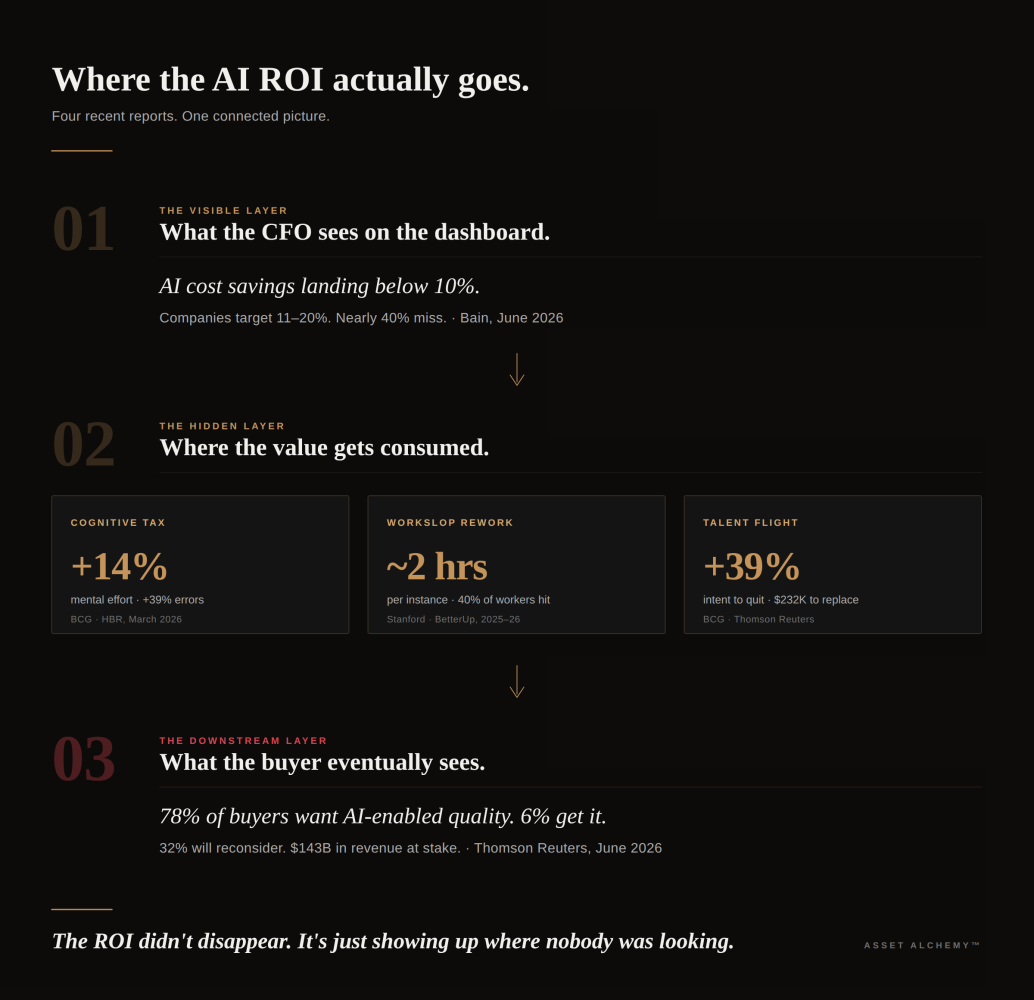
The visible layer is what the CFO sees on the dashboard.
The AI investment under delivering on projections. That's Bain.
The hidden layer is what's actually happening to the humans doing the work.
- Cognitive tax
- Workslop rework
- And talent flight
That's BCG and Stanford.
The downstream layer is what the buyer eventually sees.
Quality that doesn't match expectations, delivered by tired people making 39% more errors, produced by firms about to lose their best talent.
That's Thomson Reuters.
The ROI didn't disappear.
It got redistributed to places nobody was measuring.
You Already Know Your Dashboards Are Lying
Before we go further, I want to say something.
The reason I know that opening moment isn't a personal failing is because I've had it too.
More than once this month.
You're deep in a thread. The code almost works. You're tired.
You've recalibrated multiple times, and you don't have another correction in you.
So you accept what's on the screen. You move on, or revisit the project later on.
That moment is a microcosm of what all four studies just measured at scale.
And it's a moment nobody in the AI productivity conversation is willing to name honestly - because naming it undermines the premise that these tools are net-additive for cognition.
And here's the honest truth about measurement.
There is no "perfect" way to measure this.
People will tell you there is.
They will sell you dashboards, and frameworks.
None of them capture what's actually happening.
The losses are distributed across cognitive fatigue, downstream rework, quality degradation, and talent erosion, and no single metric holds all four.
So what do you do?
- You're gonna have to pick what you track.
- You're gonna have to be okay with the choice.
- And you are going to have to keep doing it.
Because measurement only works when it's continuous.
A one-time audit tells you nothing. What you're building is a habit of looking, not a spreadsheet.
Because what most people experience as "AI is failing me."
Is actually...
"AI is producing value; my measurement isn't capturing where it goes."
That reframing changes what you do next.
If you assume the tool is failing, you buy a different tool.
If you assume the measurement is failing, you build a habit of looking.
You are looking for a pattern, not a proof.
Five Ways to See The Tax Before It Lands On Your Desk
Not five questions. Five lenses.
You put them over what you already see, and different things become visible.
Run them on yourself first.
Then on the two largest client relationships in your book.
This doesn't need to be a formal audit.
Think of it more as a private diagnostic to shape the next conversation you have with them.
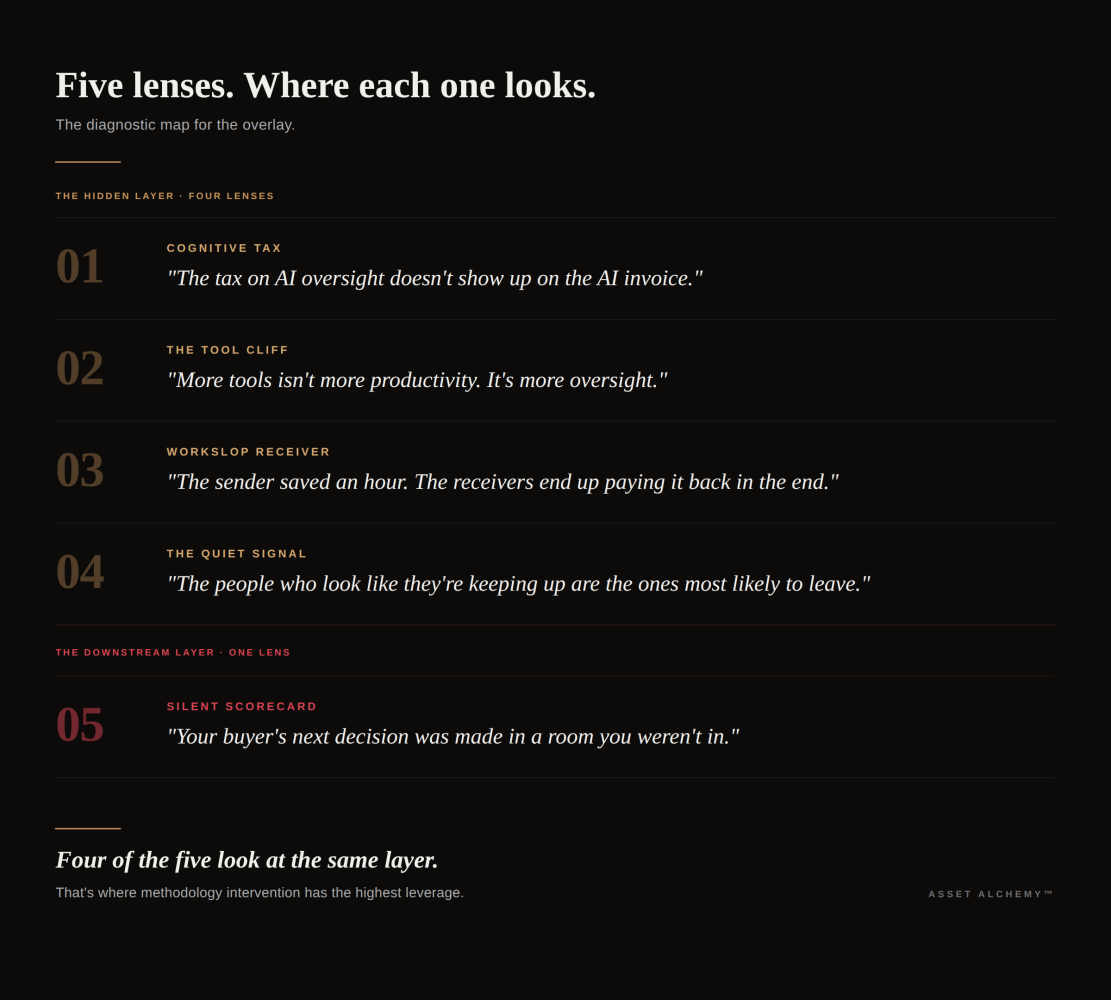
Lens 1: The tax you haven't looked at.
Look at your own week.
When you use AI for a client deliverable, does it feel lighter or heavier than doing it without?
What's the actual net?
Most people track the raw time saving...prompt to output takes twenty minutes instead of two hours.
But the twenty minutes was denser. More decisions. More attention.
More mental force per unit of time. Plus the review, the cleanup, the rewrite for voice, the fact-check, the reformatting.
That's the cognitive tax the BCG study measured.
For you: track how you feel at the end of a day heavy on AI-assisted work versus a day of comparable output without it. Not scientifically. Honestly. Your body knows before your dashboard does.
For your clients: if you advise a client whose team is deep in AI, ask them how their best people are describing the work. Not the tools. The work. What used to feel like flow now feels like managing. That shift is the tax.
AI produces time savings and cognitive costs at the same time. If you only measure one side of the ledger, the balance sheet looks wrong.
Lens 2: The three-tool cliff you already crossed.
Count them.
Your workspace has ChatGPT open. Claude. Maybe Perplexity.
Plus a design tool, a research agent, a meeting summarizer, and a CRM assistant. If that list has more than three items, you are past the productivity cliff BCG measured.
Not because AI is bad. Because managing simultaneous AI tools requires cognitive oversight that scales worse than linearly.
This is Decision Fatigue at its purest. Every tool has its own interface, its own quirks, its own trust level, its own review workflow.
The fatigue isn't in the using.
It's in the choosing which tool to use for what, remembering which tool did what last time, and holding the outputs of all of them in your head at the same time.
For you: which of your tools would you drop first if you had to? That's your least valuable one, and you knew it before you finished reading the sentence. Drop it this week.
For your clients: ask an operations lead how many AI tools any single team member touches in a week. If the answer is five or six, the company is paying for capability that's costing them productivity. They're subsidizing brain fry with a subscription budget.
More tools isn't more productivity. It's more oversight. And oversight is what breaks.
Lens 3: Every AI shortcut has a receiver.
This one is uncomfortable for most people.
The Stanford workslop research measures what happens on the receiving end of AI-generated work. It's the polished document that says nothing. The email that sounds professional but doesn't answer the question. The forty-page report that requires the reader to reverse-engineer what the sender meant.
The person who used AI saved time. The person receiving the output pays that time back and then some.
This is Synthetic Content at the operational level. Not "AI is generating slop on the internet."
Something more specific:
Your clients' internal communications are increasingly AI-drafted, which means their internal collaboration is slowing down even while individual productivity metrics look fine.
For you: when you send AI-drafted work to a client, do they respond faster or slower than they used to? Do they ask more clarifying questions? Do their responses feel more clipped? Those are workslop signals even when the output was technically clean.
For your clients: if their team is producing AI-drafted work internally, they're sending workslop to each other. That's why cross-team collaboration feels harder even when everyone's producing more. Nobody's naming it because nobody wants to be the one accused of using AI badly.
AI content offloads the thinking to the person who has to make sense of it. When everyone is doing that to everyone else, the whole system slows down while the dashboards say it is speeding up.
Lens 4: Your best people are already deciding.
The BCG study found that the workers most affected by AI brain fry were 39% more likely to be actively considering leaving.
Read that again. Not people who are burning out. Not people who are underperforming.
The most engaged users of AI - the ones deepest in the tools, the ones the company would call its early adopters - are the ones most likely to be looking for the exit.
This is Inflationary Pressures at the human level. Your best people are paying the highest tax on AI oversight, and the return they're getting isn't compensating for it.
For you: watch yourself first. When was the last time you felt genuinely energized by a piece of work, not just efficient? When was the last time you closed your laptop feeling like you had built something rather than managed something? Those aren't soft questions. They are the leading indicators of the same decision your best team members are quietly making.
For your clients: their best people are the ones running the most AI oversight, which means they're the ones closest to burning out. That is not because AI is failing. It is because the work around AI wasn't redesigned when AI showed up. The tools were dropped in; the workflows weren't rebuilt to match.
The people who look like they are keeping up are the ones most likely to leave.
Lens 5: They've already priced you. They just haven't told you.
Thomson Reuters measured that 78% of corporate clients see AI-enabled quality as essential. Only 6% say providers deliver it.
That gap doesn't stay silent. It shows up as slower renewals, shorter contract terms, quieter meetings, RFPs that used to be uncontested going out to multiple bidders.
The buyer isn't going to tell you they're reconsidering until they've decided.
Which means the diagnostic has to happen before the conversation, not during it.
This is Buyer Bottlenecks at the delivery layer. Post #1 in this 4-part series named the buyer-reconsideration risk. This lens names how you catch it before the client does.
For you: which of your top three client relationships has changed tone in the last six months? Not dramatically. Slightly. A meeting that felt collaborative now feels transactional. A response time that used to be four hours is now twenty. Those are pre-language signals. They matter.
For your clients: the same dynamic exists downstream. Their buyers are running the same scorecard. Your client isn't going to hear about it until it shows up in a renewal conversation. You can see it before they can - because you're one seat back from the immediate feedback loop.
By the time the buyer names the gap, they've already priced it into their next decision.
What All Five Lenses Are Really Measuring
Notice what all five have in common.
Every one of them is about protecting the human capacity that AI is supposed to amplify but is often depleting instead.
- Cognitive capacity in Lens 1.
- Attention capacity in Lens 2.
- Communication capacity in Lens 3.
- Emotional capacity in Lens 4.
- Relational capacity in Lens 5.
That's the underlying game.
Right now the dominant AI commentary is telling you the answer is a Chief AI Officer, a new tool stack, or an enterprise governance framework.
Those aren't wrong.
They're just addressing the wrong layer of the problem.
The layer that's actually being consumed isn't governance. It's capacity.
And no CAIO has ever protected a single person's capacity, because the capacity crisis lives in the work itself, not in the org chart above it.
What protects capacity at the work layer is your unique methodology.
A documented, extracted, captured, running signature methodology that carries the judgment of your best people so the AI is amplifying a defined pattern instead of improvising from scratch every time.
That's the intervention.
- Documented methodology reduces cognitive oversight burden.
- Extracted judgment reduces workslop.
- Captured IP reduces talent flight risk.
- Productive credit allocation reduces the tool proliferation that produces the three-tool cliff.
This is the reason I've spent the last several years building the Asset Alchemy Method around signature methodology as the central asset.
Not because methodology is prettier than tools.
Because methodology is the only thing that makes the tools survivable...for you, for your team, and for your clients.
If you don't have a signature solution documented and running, you don't have a way to protect what AI is consuming.
And if your clients don't have theirs, the same thing is happening to them at the same rate.
Three weeks ago I wrote If You're Worried You're Falling Behind on AI, You're Reading the Wrong Instrument - three moves that compound past your competitors without adding another AI tool.
The five lenses in this piece are the diagnostic.
That piece is the operational move.
One lens. Three days. One conversation.
One lens. Not five.
Pick the one that made you uncomfortable when you read it.
The one where you thought "oh" and kept reading a little faster. That's the one worth running.
Run it on yourself first.
Give it three days. Not to solve anything. To notice.
Then run the same lens on your two largest client relationships.
Not as an audit. Not as something you announce.
As a private diagnostic to shape the next conversation you have with them.
Post 1 named what's happening to your clients.
This piece named the mechanism inside of it.
Stay tuned in for the next issue.
Here's what I want you to watch for between now and then.
Tomorrow, or the day after, you'll be in that thread again.
You'll feel the moment where you tell yourself it's good enough and you move on.
When it happens, don't push past it.
Stop for ten seconds.
Not to diagnose. Not to fix. Just to notice that you noticed.
That's the beginning of the pattern I asked you to look for at the start of this piece.
Not proof. Not measurement. A habit of looking.
That's the whole ask.
Stay sharp,
Colin Taylor
Creator of The Asset Alchemy Method™
Sources
Bain & Company, "Your AI Budget Is Growing. Your Returns Aren't. Here's Why." (June 1, 2026) https://www.bain.com/insights/your-ai-budget-is-growing-your-returns-arent-heres-why/
Julie Bedard et al., Boston Consulting Group / Harvard Business Review, "When Using AI Leads to 'Brain Fry'" (March 5, 2026) https://hbr.org/2026/03/when-using-ai-leads-to-brain-fry
Kate Niederhoffer, Alexi Robichaux, and Jeffrey Hancock, Stanford Social Media Lab and BetterUp Labs, "AI-Generated 'Workslop' Is Destroying Productivity" (September 2025) and "Why People Create AI 'Workslop', and How to Stop It" (January 2026) https://hbr.org/2025/09/ai-generated-workslop-is-destroying-productivity
Thomson Reuters, "AI is Ready but Firms are Not" (June 22, 2026) https://www.thomsonreuters.com/en/press-releases/2026/june/ai-is-ready-but-firms-are-not-how-falling-behind-on-ai-implementation-is-costing-clients-and-talent
Frequently Asked Questions
Why do AI implementations fail to deliver ROI?
AI ROI often doesn't disappear, it gets redistributed into costs no dashboard measures. Bain found 44% of companies fund their next AI round on returns that didn't fully materialize. BCG found the strain comes from AI oversight, not AI use, with affected workers making 39% more errors. Stanford found workslop rework costs roughly two hours per instance. The productivity is produced, then consumed by cognitive fatigue, downstream rework, quality degradation, and talent flight before it reaches the P&L.
What is workslop and how does it affect a business?
Workslop is a term coined by Stanford's Social Media Lab and BetterUp Labs for AI-generated content that looks polished but lacks the substance to advance a task. It offloads cognitive work to the recipient. The sender saves time, but colleagues downstream each spend time reverse-engineering the output, producing net-negative productivity that only shows as the original worker's time savings on any dashboard. Stanford found 40% of workers encountered workslop in the past month at a cost of roughly two hours of rework per instance.
How many AI tools should one person use at once?
BCG research found productivity peaks at three simultaneous AI tools and declines after that. Managing multiple AI tools requires cognitive oversight that scales worse than linearly. If a single team member touches five or six AI tools in a week, the company is paying for capability that is costing productivity, because the fatigue lives in choosing which tool to use and holding all their outputs in mind at once.
What foundation does a business need before implementing AI?
A documented signature methodology. The layer AI consumes is human capacity, not governance, so a Chief AI Officer or new tool stack addresses the wrong layer. A documented, extracted, captured methodology carries the judgment of your best people so AI amplifies a defined pattern instead of improvising from scratch. This reduces cognitive oversight burden, reduces workslop, reduces talent flight risk, and reduces the tool proliferation that produces the three-tool productivity cliff.
How do you know if a client is quietly reconsidering the relationship?
Thomson Reuters found 78% of corporate clients see AI-enabled quality as essential while only 6% say providers deliver it, and 32% will reconsider provider relationships within twelve months. The gap surfaces as slower renewals, shorter contract terms, quieter meetings, and previously uncontested RFPs going out to multiple bidders. Buyers do not announce reconsideration until they have decided, so the diagnostic has to happen before the conversation, not during it.