A Dave Chappelle clip came across my feed this week.
"It just seems like thinking is for poor people."
I laughed.
But it was his point about character being the only thing left that stayed with me.
I've been circling that with four letters and a whiteboard all year.
Knowledge. Attitude. Skills. Habits.
You can already see AI making knowledge and skills cheaper to access: the research, the summary, the first draft.
Which puts more weight on the other two in my opinion. What someone takes responsibility for, and whether they follow through.
Because the person who can suddenly do more for your business can also do more without it.
- They can build a product.
- Find faster-moving clients.
- And pursue an idea that doesn't need another meeting to explain.
Will they still bring you the better option? Push you to understand it? Stay long enough for your clients to benefit?
That takes character.
The part I'm interested in is what I call Ethical Endurance: sustaining your responsibility to the people you serve as the cost of honoring it grows.
I named it in January's Gut-Check. What I hadn't worked through was what it asks of both sides of a client relationship.
- The fortieth decision, when the easy answer would pass.
- The difficult conversation you could avoid.
- The better result you keep working toward while another opportunity competes for your attention.
Of course, following through isn't exclusively human territory either. OpenAI reports roughly three agent-workdays of research per human workday.
So we can't assume the machine will always need us to tell it what to do.
As it can do more, what are you still responsible for?
Someone still has to answer for the outcome. And someone has to care enough to question whether the easy result is the right one.
Here are seven changes I'd expect in your business over the next year.
1. More clients will arrive having done the first pass themselves.
The reading hasn't vanished.
It's moved to their side of the table, and they think it was free.
Your explanation (and worldview) competes with one they already have.
And simply repeating it won't show them why they need you.
What couldn't they work out on their own?
And what made them trust you to help?
- The move: Ask three recent clients what they still couldn't decide when they contacted you. Use what you learn to explain your value in the next proposal.
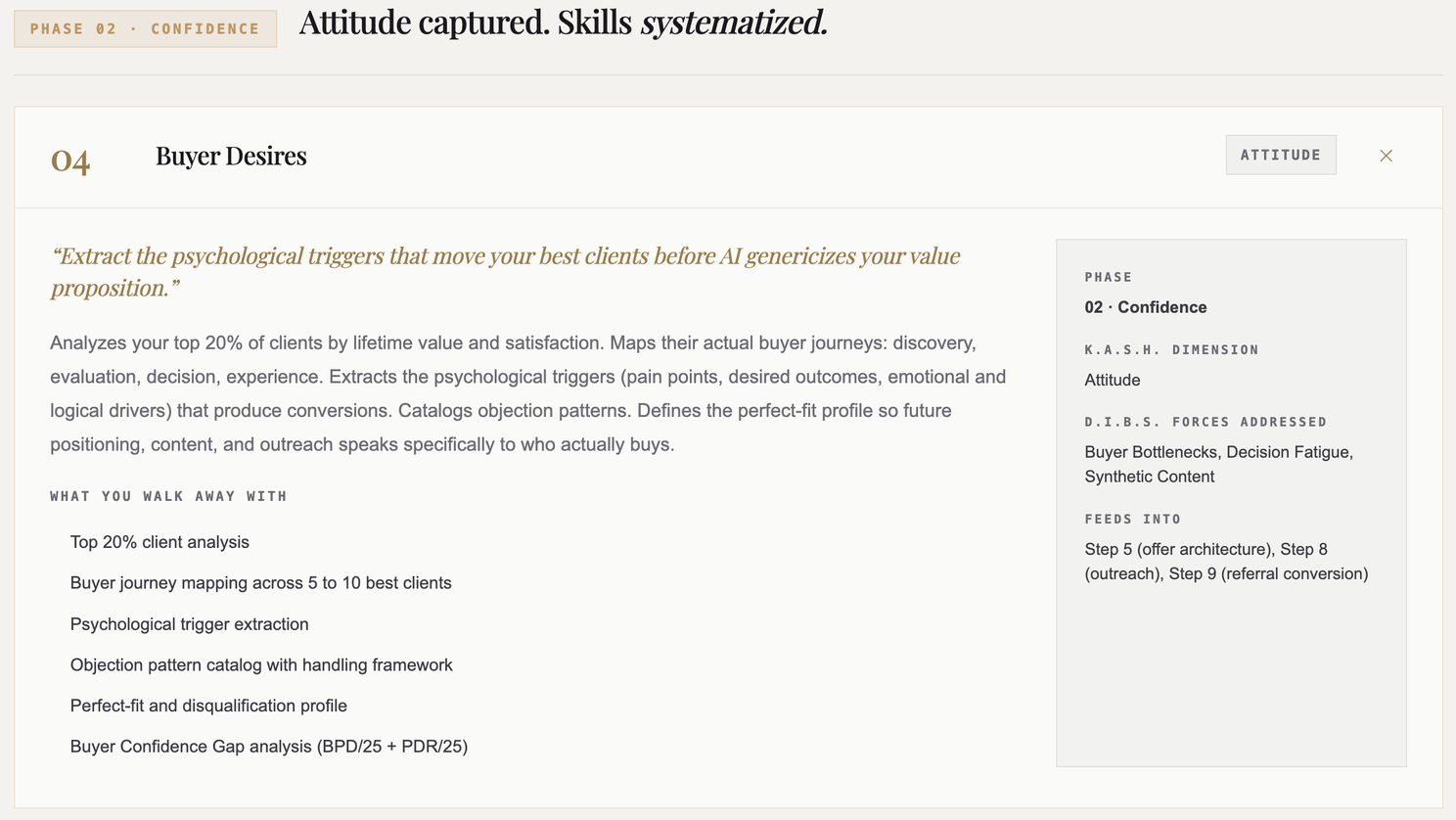
That's where Buyer Desires starts. A model won't know those answers (faithfully) unless somebody gathers them.
2. More advisory work will be priced against an agreed outcome.
The Financial Times recently reported Bristol Myers Squibb pressing advisors toward fixed and performance-based fees.
That puts pressure on hours. It also creates an opening for anyone who can show what the work accomplished.
Bristol Myers Squibb isn't necessarily asking for cheaper. It's asking for provable, which is an entirely different request.
I stopped sending conventional invoices seven years ago.
- A proposal lists what I'll do.
- An invoice lists what I did.
Both give the client a list of work to price. Neither necessarily spells out what they'll need to do for that work to truly succeed.
My clients get a document titled Outcome Agreement instead.
The name matters less than what it asks of both of us: I owe the work; they owe the access, the decisions, and the willingness to change something.
The document says so, in writing, before anybody starts.
That's a harder conversation to have up front. It's a much shorter one later.
What the agreement still doesn't do is prove anything. It's a promise, and promises get made in advance.
So there's a second document, written afterward, that shows what actually changed.
That matters more every month, because producing something impressive keeps getting easier than making something improve and measuring why.
- The move: Write the evidence document first. Decide what would count as success before pricing the promise.
3. Buyers will bring you AI answers they need someone to stand behind.
Forrester found widespread generative AI use among buyers. Gartner found buyers still turning to people to validate machine answers.
I got the drive-through version last week.
A woman at my coffee spot knows what I do. Last week she asked how "the AI thing" was going, then announced to her coworkers that I'm an "AI supporter."
One of them said..."Everybody uses it a little for something every day anyway".
Your buyers can sound like that too: skeptical when the subject comes up, already using it when there's something to get done.
Which is why the call isn't nostalgia.
They need someone to check the answer, recognize what's missing, and take responsibility for the recommendation.
- The move: Ask your next prospect what they've already asked AI, and which part they still don't trust.
4. Keeping your best people's attention will become harder.
This one's for you as the person running the business.
I think it's the one most people are underestimating.
Everyone's already carrying something. The economy feels unsteady, the politics feel unstable, and most owners I talk to are managing a low-grade dread they don't say out loud.
Meanwhile, the advisors and providers who see what AI makes possible for you also see what it makes possible for them.
As those alternatives get easier to pursue, they have more reason to reconsider where their effort goes.
And you need another conversation. Your team isn't ready. The change makes sense, but implementing it is slow.
Sometimes hesitation is reasonable, but sometimes it's straight up avoidance. A good partner has to work out which, and care enough to tell you.
That's the ethical endurance you need from them: continuing to bring the better option forward, having the difficult conversation, and honoring their commitments while other opportunities compete for their attention.
You can reasonably expect them to raise concerns before quietly pulling back. You can't expect them to stay indefinitely if you're unwilling to act.
Which makes this a question about the kind of client you are, too.
You can't keep asking for someone's best thinking while refusing to engage with it.
They still answer your emails. The work still arrives. But you haven't heard "I've been thinking about your business" in months.
- The move: Ask your most important provider: "What could we be doing better that you've stopped bringing up?"
Then listen.
5. The reasons behind your decisions will become more valuable.
Research on AI's "hivemind" tendency points to different models converging on similar answers.
Your value increasingly lives in recognizing why an answer won't work here.
AI lets less experienced people attempt useful work sooner.
Sometimes they succeed. Sometimes they miss a constraint an experienced person would catch.
If you can see what they missed, explain it. That's how the client sees the value of your experience.
Where mistakes can't be undone, the expertise needs to be there before anyone starts.
- The move: Write down one option you rejected last month. Include the detail that made the obvious answer wrong.
That's one of the simplest ways to start making sure expertise becomes transferable.
6. More firms will discover how much of their method belongs to a vendor.
Access feels like ownership until a price, permission, or feature changes.
Then you discover whether your method can survive a change of software.
- Could you move your client history?
- Your decision rules?
- The examples that teach someone what good work looks like?
Your commitment to a client is harder to honor when a vendor controls whether you can deliver.
- The move: Choose one tool you depend on. Write down what you could take with you tomorrow and what you'd have to rebuild.
Renting capability makes sense, I'm not arguing against that.
Just ask: if this tool changed tomorrow, how would we keep serving the client?
7. Well-supported disagreement will become more scarce.
A confident model answer can feel like everybody agreeing at once.
Challenging it takes effort, especially when you're busy and it seems reasonable.
Sometimes the obvious answer is right.
Being different has no value by itself.
But someone who notices an exception, tests it, and explains why it matters gives a client a reason to trust their judgment.
- The move: Next time you distrust an AI answer, write down why before looking for support. Then test what would prove you wrong.
Build a record of whether your judgment holds up.
I made eight predictions in January. Seven held up.
The one I got wrong?
I expected the best people to take their knowledge out the door faster. The exits came slower, but the strain came right on time.
I'll grade these seven next year.
One thing I'd do this week
Pick one recent client decision where you felt pressure to take the easy answer, move on, or put your attention somewhere else.
Write one sentence for each:
- The situation: What did the client need?
- The pressure: What made another option easier or more attractive?
- The judgment: What did you notice that shaped your decision?
- The choice: What did you decide, and why?
- The follow-through: What did you actually do?
- The result: What happened, or what are you still waiting to find out?
Six questions about one real decision.
Keep doing this and you'll begin to see a pattern: where your judgment holds up, where you fall short, and what someone else could learn from both.
Over time, that becomes a character record. Your principles show up in the choices you make and the commitments you keep.
That's what stayed with me from Chappelle's point.
AI gives you more things you could do.
Your clients still need you to choose carefully and see their work through...even as your alternatives multiply.
That's worth teaching someone.
It's also worth hiring for.
Stay surgical,
Colin Taylor
Creator of The Asset Alchemy Method
P.S. Include the call you got wrong. What you missed, and what you changed afterward, may be the most useful thing the next person learns from you. That belongs in a character record too.
Frequently Asked Questions
What happens to expert businesses when AI makes knowledge and skills cheaper?
Two of the four K.A.S.H. categories, Knowledge and Skills, get cheaper to access as AI handles research, summary, and first drafts. That shifts the value to the other two: Attitude and Habits. What someone takes responsibility for, and whether they follow through. Expert-led businesses that survive the shift are the ones that can show their judgment and their follow-through, not just their output.
What is the K.A.S.H. Framework?
K.A.S.H. stands for Knowledge, Attitude, Skills, and Habits. It is the four-category model used in The Asset Alchemy Method to extract institutional knowledge from a business. Knowledge is what you know, Skills are what you can do, Attitude is what you take responsibility for, and Habits are whether you follow through. AI is compressing the first and third. The second and fourth are where defensible value now sits.
How do you document judgment so your expertise transfers to other people?
Record real decisions, not procedures. For one recent client decision, write a single sentence for each of six prompts: the situation, the pressure, the judgment, the choice, the follow-through, and the result. Include the calls you got wrong. Repeated over time this becomes a character record that shows where your judgment holds up and gives the next person something to learn from. Writing down the option you rejected, and the detail that made the obvious answer wrong, is the fastest starting point.
How do I tell whether my method belongs to me or to a software vendor?
Access feels like ownership until a price, permission, or feature changes. Pick one tool you depend on and write down what you could take with you tomorrow and what you would have to rebuild: client history, decision rules, and the examples that teach someone what good work looks like. If those live only inside the vendor, your commitment to a client is harder to honor when the vendor changes the terms.
What is ethical endurance in a client relationship?
Ethical Endurance is sustaining your responsibility to the people you serve as the cost of honoring it grows. In practice it means the fortieth decision when the easy answer would pass, the difficult conversation you could avoid, and the better result you keep working toward while another opportunity competes for your attention. It runs both directions: a client cannot keep asking for someone's best thinking while refusing to engage with it.